Last reviewed: November 20, 2026
When I first looked into OpenAI’s new ChatGPT Wallet, I had one question: Does this mean customers will soon be able to buy products from small online stores without going through the usual shopping process?
The answer is more complicated than the announcement makes it sound.
OpenAI introduced ChatGPT Wallet on November 13, 2026. The basic idea is that an AI agent can help complete a purchase using a card the customer has saved, with the customer reviewing and authorizing the transaction. It’s a meaningful step beyond asking ChatGPT to recommend a product.
But there’s a catch. Wallet is rolling out to a limited group of eligible U.S. ChatGPT Pro users through dots. It isn’t a payment button that every ChatGPT shopper can use today. And a product appearing in ChatGPT doesn’t prove that its store can complete a Wallet-assisted purchase.
So what should someone running a Shopify store—or any small ecommerce business—actually do?
After reviewing OpenAI’s announcement, developer guidance, and Shopify’s documentation, my conclusion is pretty simple: I wouldn’t pay for a special Wallet integration right now. I’d first check a few things about the store I already have.
Table of Contents
First, what does ChatGPT Wallet actually do?
Think about the last time you bought something online. You probably searched, compared a few options, opened a store, entered checkout details, and paid. AI assistants have been getting better at the first half of that journey. Wallet is about helping with the payment step.
In the initial experience, an eligible customer can save a supported card and approve a purchase that an agent has prepared. OpenAI says the payment uses a network token rather than handing the underlying card number to the agent or merchant.
The restrictions matter. At launch, availability is limited to eligible adults in the United States with ChatGPT Pro and supported U.S.-issued cards. The experience is through dots, not ordinary ChatGPT conversations or ChatGPT Work, and rollout is gradual.
That’s a much smaller starting audience than the phrase “ChatGPT payments” might suggest.
A realistic example—and what we haven’t tested
Imagine a customer wants a $200 office chair. They ask an agent to find a comfortable option, compare prices, and prepare an order. The agent reaches a merchant’s checkout. The customer reviews what they’re buying and authorizes the payment. The merchant still handles the order, shipping, returns, and customer service.
That is an illustrative scenario, not a BetterBizLab transaction. We haven’t completed a live Wallet purchase, so I can’t tell you that a particular Shopify checkout or fraud setup works flawlessly with it.
That distinction is important. A product announcement tells us what a system is designed to do. It doesn’t tell us how often it succeeds across thousands of real-world stores.
Getting discovered isn’t the same as getting paid
This is the part I think many store owners could easily miss.
ChatGPT Shopping and product discovery help customers find products. ChatGPT Wallet helps an eligible customer authorize a purchase. Those are separate problems.
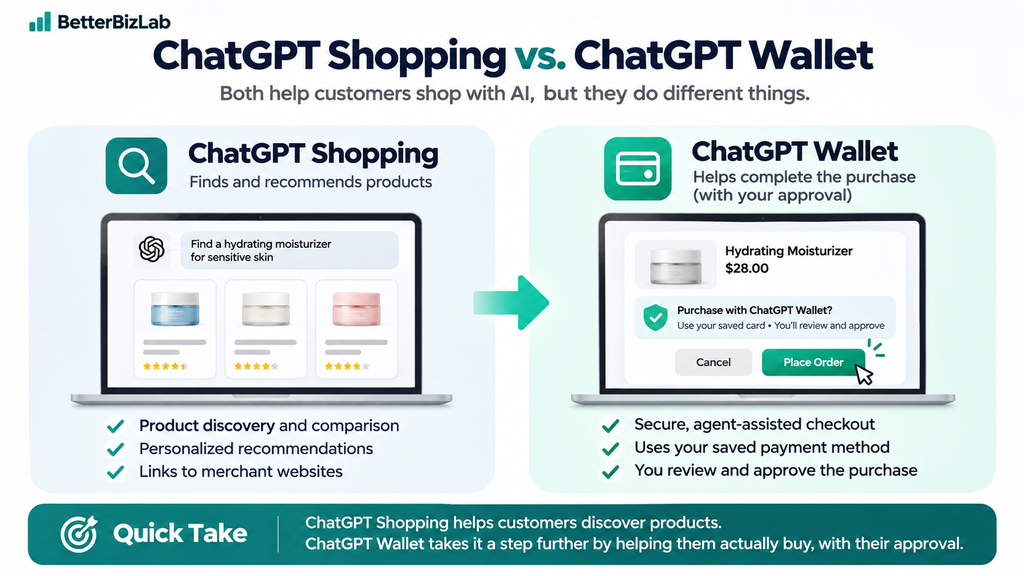
ChatGPT Shopping helps customers discover products, while ChatGPT Wallet supports authorized purchases. Illustration by BetterBizLab.
A store might have clear product data and show up in an AI recommendation but still run into checkout problems. Another store might have a perfectly functional checkout and never appear in a relevant product recommendation.
If you’re working on the discovery side, our guide on how to get your small business recommended by ChatGPT covers that different challenge.
Don’t buy a “Wallet optimization” service expecting it to make ChatGPT recommend your products. There’s no basis for that promise.
Do stores need to install anything?
Here’s the encouraging part: OpenAI’s developer guidance says a dedicated Wallet-specific integration is not required. The goal is to work with existing merchant checkouts.
But “no special integration required” isn’t the same as “every checkout is confirmed compatible.” A firewall could block an agent. An account login could interrupt the process. A fraud tool could reject a legitimate tokenized transaction.
If I were reviewing a small store this week, I’d ask five practical questions.
1. Can customers—and legitimate agents—find accurate product information?
Start with the boring stuff: prices, availability, product names, shipping terms, and return policies. If a product page says one thing and checkout says another, an agent won’t fix that inconsistency.
This is worth doing regardless of Wallet. Clean catalog information supports regular shoppers and product discovery, too.
2. Is the website blocking the wrong traffic?
Many stores use bot protection, and they should. The question isn’t whether to turn it off; don’t. The question is whether the site’s security provider can distinguish supported, authenticated agent activity from unwanted automation.
OpenAI’s Commerce Partner Playbook discusses cloud-browser access and Web Bot Auth. I’d send that documentation to whoever manages the site’s firewall or CDN before touching any settings. For a small merchant, this may be a question for a hosting provider rather than a development project.
3. Does checkout work reliably today?
Try the ordinary customer path first. Can someone add an item, see the correct shipping and tax total, and finish checkout without confusing redirects? Are out-of-stock products handled properly? Does account creation introduce unnecessary friction?
I wouldn’t label a store “Wallet-ready” based on a normal checkout test. But a broken checkout is a problem you already have, and fixing it is useful now.
4. What does your payment or fraud provider say?
OpenAI says Wallet uses network tokens, but a payment can still be declined by a merchant’s risk controls. Rather than switching processors, I’d ask the current provider: Do you have guidance for authenticated AI-agent purchases? How would we identify a false decline? Are there settings we should review?
If the answer is “we don’t know yet,” that’s useful information. Document it and revisit later.
5. Would you even know if AI shopping generated sales?
This is where I would spend more attention than money. Know your current referral traffic, checkout conversion rate, and failed-payment rate. Then you’ll have something to compare when agent-assisted shopping becomes more common.
Be careful with attribution. A visit from ChatGPT is not proof that Wallet was used, and a Wallet transaction shouldn’t automatically be credited to a particular recommendation. Our guide to tracking AI traffic in GA4 explains what referral analytics can—and cannot—show.
What about Shopify stores specifically?
Shopify’s documentation says eligible merchant product information can be surfaced through Shopify Catalog for ChatGPT discovery, with customers directed to the merchant’s own checkout.
That is useful, but it answers a discovery question. The Shopify guidance reviewed for this article does not establish that every Shopify checkout automatically accepts ChatGPT Wallet transactions.
For a Shopify owner, I would keep the action list short: make sure catalog data is correct, confirm the storefront and checkout work normally, and ask existing payment and security providers about agent-assisted transactions. I would not install a third-party plugin claiming to be essential for Wallet without clear documentation.
Wallet also doesn’t replace Shopify Payments, Stripe, or your ecommerce platform. The merchant’s existing checkout and operational systems remain part of the transaction.
What I would not do yet
I wouldn’t rebuild a checkout around a feature with a limited rollout. I wouldn’t promise customers that they can pay through Wallet on a particular store without verifying it. And I wouldn’t forecast extra revenue based on an announcement alone.
That isn’t a dismissal of agentic commerce. It may become a major change in how people shop. But for a small business, the opportunity cost of chasing every new AI release is real.
The more useful question is: What can I improve this week that helps customers now and keeps the door open for AI shopping later? Accurate listings, accessible pages, dependable checkout, and sensible fraud controls all pass that test.
For background on agents more generally, see AI Agents for Small Business: Do You Need One?. If your team is still working out practical uses for the tools, start with how to use ChatGPT for small business.
Quick answers to the questions merchants are asking
Can anyone with ChatGPT use Wallet? No. The initial rollout is limited to eligible adult U.S. ChatGPT Pro users with supported cards through dots, and access is gradual.
Can the agent spend money without the customer’s approval? The announced initial experience includes customer review and authorization. Broader delegated purchasing concepts should not be treated as live features.
Do I need a Wallet plugin? OpenAI says no dedicated Wallet-specific integration is required. That is not a guarantee that every merchant setup works.
Will Wallet make my products appear in ChatGPT? No. Discovery and payment are separate.
Does every Shopify store support Wallet today? That has not been confirmed by the official Shopify guidance reviewed here.
Did BetterBizLab test a live Wallet transaction? No. This article is based on official documentation and clearly labeled examples, not firsthand checkout testing.
My takeaway
ChatGPT Wallet is worth paying attention to. It makes the idea of an AI agent moving from product research to an authorized purchase more concrete.
But for the average small ecommerce business, the immediate response shouldn’t be a new software subscription or a rushed integration. It should be a quick review of the store you already operate—and a healthy skepticism toward anyone promising instant AI-driven sales.
If adoption grows, there will be time to invest further. For now, I’d rather have a reliable checkout and accurate products than a “future-proof AI commerce” badge that doesn’t mean anything.
Official sources
- OpenAI — Introducing ChatGPT Wallet
- OpenAI Help Center — Making Purchases With ChatGPT Wallet
- OpenAI Developers — Commerce Partner Playbook
- OpenAI Developers — Accept Payments
- OpenAI — Powering Product Discovery in ChatGPT
- Shopify Help Center — Selling on ChatGPT
Editorial disclosure: BetterBizLab has not independently tested a live ChatGPT Wallet purchase. Availability and technical requirements may change; verify the current official guidance before making changes to your store.