Learning how to get your business recommended by ChatGPT is becoming a new challenge for small-business owners.
Getting ChatGPT to recommend it when a potential customer asks, “Which company should I use?” is a different challenge.
We wanted to see what that actually looks like for a real small business, so we ran a simple experiment.
We used a real U.S.-based B2B company that has been operating for years, works with established retail partners, has multiple distribution facilities, and maintains an active business website.
Then we opened fresh ChatGPT conversations and asked realistic questions a potential customer might use to find companies in its industry.
The result surprised us.
ChatGPT could understand the company remarkably well when we asked about it by name.
But when we asked broader customer-style questions, the company usually disappeared from the recommendations.
That distinction matters.
ChatGPT knowing your business exists does not necessarily mean ChatGPT will recommend your business when someone is looking for what you sell.
So we investigated the businesses ChatGPT recommended instead.
Here’s what we found—and what small businesses can realistically do about it.
We Tested a Real Small Business in ChatGPT
We didn’t want to test a fictional plumbing company or create a website specifically for this experiment.
Instead, we used a real operating U.S. B2B business.
To avoid turning this article into promotion for that company, we’ll keep its identity private and refer to it as our test business.
We ran six tests in separate ChatGPT conversations so that information from one conversation wouldn’t influence the next.
We also kept the first response rather than regenerating answers until we got the result we wanted.
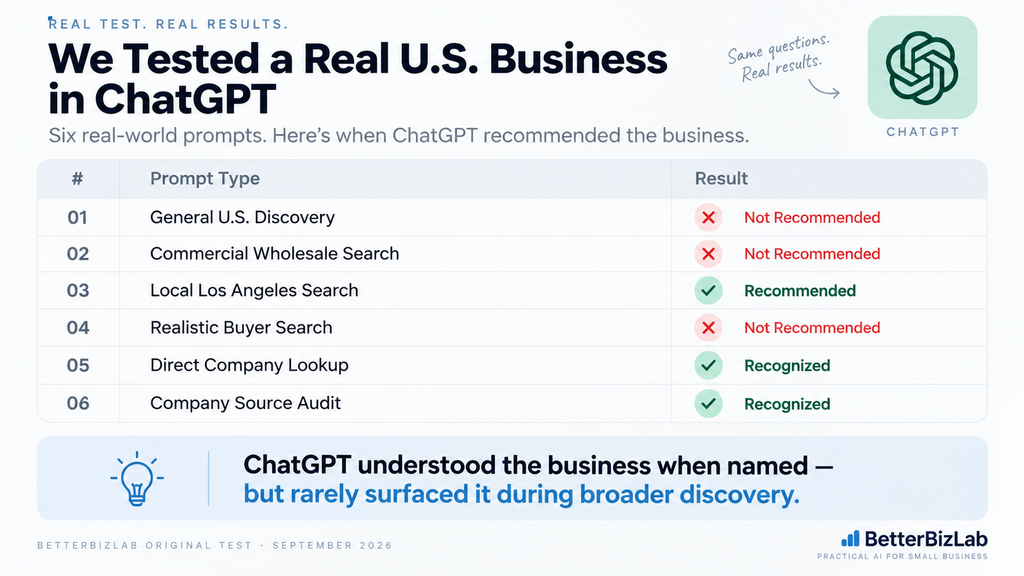
Test 1: General discovery
We asked ChatGPT for U.S. distributors in the company’s industry that retailers could use to source products.
Our test business wasn’t recommended.
Test 2: Commercial intent
We changed the wording to make the purchasing intent stronger.
Again, the test business didn’t appear.
Several competing companies from Test 1 appeared again.
Test 3: Local discovery
Next, we added a specific geographic constraint and asked for distributors in the Los Angeles area that work with retailers.
This time, our test business appeared.
ChatGPT not only identified the business but also connected it with a related business entity using information it found online.
Test 4: Realistic buyer intent
We removed the location again and framed the prompt from the perspective of a small U.S. retailer actively looking for a wholesale supplier.
Our test business disappeared again.
Several of the same competitors from Tests 1 and 2 were recommended.
Test 5: Direct entity recognition
Then we stopped asking for recommendations and simply asked ChatGPT what our test business was and what it did.
The result was completely different.
ChatGPT accurately identified its location, business model, services, distribution capabilities, and related business operations.
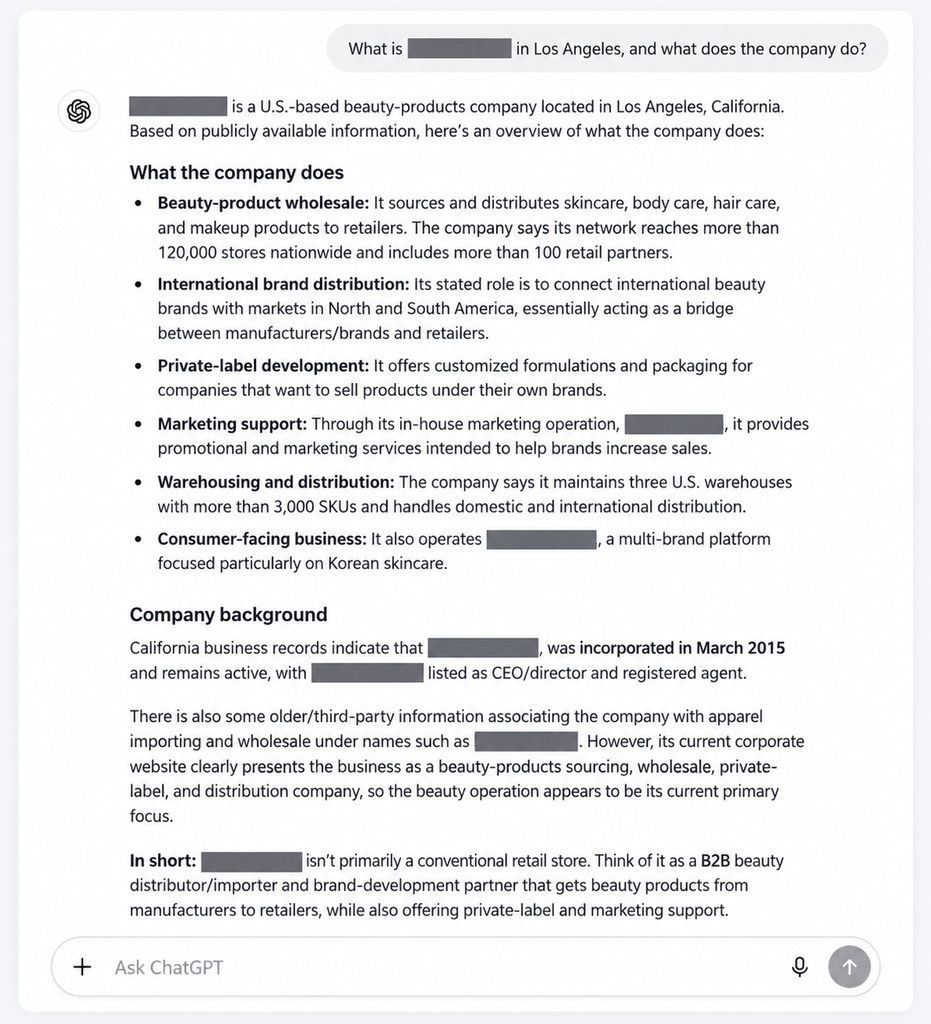
In other words, ChatGPT clearly knew what the company was.
Test 6: Source audit
Finally, we asked ChatGPT to show the sources it used to understand the company.
Its primary source was the company’s own website, supplemented by a small number of public business-record sources.
This gave us our most important finding.
AI Entity Recognition Is Not the Same as AI Recommendation Visibility
Our test business wasn’t invisible to ChatGPT.
Quite the opposite.
When we provided the company’s name, ChatGPT understood the business surprisingly well.
The problem appeared earlier in the discovery process.
When a potential customer described what they needed without naming the company, ChatGPT usually recommended other businesses instead.
That’s an important distinction for small-business owners.
You could ask ChatGPT:
“What does [Your Company] do?”
and receive a perfect description.
But a prospective customer could ask:
“What companies can help me with [your service]?”
and never see your company.
We can’t determine from six prompts exactly why ChatGPT selected one business over another. AI recommendations can be affected by retrieval, search results, relevance, available web sources, query wording, location, freshness, and other factors that aren’t visible to us.
But we could investigate something observable:
What did the businesses ChatGPT repeatedly recommended have in common?
What the Recommended Businesses Did Differently
We reviewed several businesses that appeared repeatedly across our discovery tests.
One pattern stood out quickly.
Their websites made the relationship between the company, category, customer, service, and location extremely easy to understand.
Instead of relying primarily on broad marketing language, they frequently used direct descriptions equivalent to:
We are a U.S.-based [category] distributor serving [specific customer type].
The pages clearly answered questions such as:
Who are you?
What exactly do you sell or provide?
Who do you serve?
Where do you operate?
Do you offer wholesale or another specific commercial service?
Our test business had plenty of information online, including strong business credentials and detailed descriptions of its services.
But its positioning was broader.
It presented multiple capabilities—distribution, sourcing, wholesale, private label, marketing, warehousing, and other services.
That’s valuable from a business perspective.
But compared with some businesses ChatGPT repeatedly surfaced, the connection between one specific customer query and one specific commercial service wasn’t always as direct.
That doesn’t prove this caused the recommendation difference.
It does suggest a useful principle:
Don’t make customers—or AI systems—work unnecessarily hard to understand exactly who your business helps and what you help them do.
If you’re still building your overall ChatGPT workflow, our How to Use ChatGPT for Small Business guide covers 10 practical ways to use it in day-to-day operations.
1. Describe Your Business With Specific Language
Marketing copy and descriptive copy serve different purposes.
Consider these two hypothetical homepage descriptions:
“Your trusted partner for business growth.”
versus:
“We provide bookkeeping and payroll services for small businesses with 5–50 employees in Dallas, Texas.”
The first might sound better in a branding presentation.
The second communicates much more information.
It identifies:
Service: bookkeeping and payroll
Customer: small businesses
Customer size: 5–50 employees
Location: Dallas, Texas
You don’t need to stuff keywords into every paragraph.
You do need enough plain-language specificity for a person unfamiliar with your company to understand it immediately.
If you’re learning how to get your business recommended by ChatGPT, this kind of clarity is a practical place to start.
A useful test is to show your homepage to someone outside your industry for ten seconds and ask:
What does this company sell, and who is it for?
If they can’t answer, your website may be relying too heavily on branding language.
2. Create Pages Around Real Customer Needs
One difference we observed among several businesses ChatGPT surfaced was the presence of pages built around specific commercial needs.
For example, instead of putting everything under a generic “Services” page, a company might have dedicated pages for:
Wholesale
Retailer partnerships
Private label
Distribution
Enterprise customers
Local services
This isn’t about creating hundreds of thin SEO landing pages.
Each page should genuinely help the intended customer.
A useful wholesale page, for example, might explain:
Who qualifies for wholesale pricing.
What types of businesses you work with.
What product categories you carry.
Where inventory is located.
Whether there are minimum orders.
Which markets or regions you serve.
How retailers can apply.
What happens after they submit an application.
The goal is to make each important business relationship understandable on its own.
3. Make It Clear Who You Serve
Many company websites spend enormous amounts of space explaining themselves while barely describing their customers.
That’s backwards.
If your customers include restaurants, dentists, retailers, contractors, manufacturers, salons, agencies, or businesses of a particular size, say so where it naturally helps the reader.
Instead of:
“We provide advanced automation solutions.”
try something more informative:
“We help small accounting firms automate client intake, document collection, and appointment follow-ups.”
That sentence establishes relationships that are useful to both customers and systems trying to understand the page.
Your content should naturally answer:
Who uses this?
What problem are they trying to solve?
What happens after they use it?
4. Don’t Hide Your Location and Service Area
Our own experiment produced an interesting result.
The test business didn’t appear in several nationwide recommendation prompts.
When we added a local geographic constraint, it appeared.
One experiment isn’t enough to conclude that local optimization caused the change.
But it reinforces a simple best practice: make your geography clear when geography matters to your customers.
That could include your:
Business address.
Primary service area.
Cities or states served.
Warehouse or office locations.
Shipping coverage.
Local service pages when genuinely relevant.
Your website shouldn’t force someone to search through the footer or a contact form to figure out where you operate.
5. Build Evidence, Not Just Claims
Our test business actually had substantial credibility signals on its website.
That included operational statistics, facilities, retail reach, and years of experience.
Yet those signals alone didn’t guarantee inclusion in broader ChatGPT recommendations.
This is another useful lesson.
Authority and relevance are not the same thing.
A business can be established and credible while still being difficult to match to a particular customer request.
Use proof to support clear positioning rather than substitute for it.
Depending on your business, useful evidence might include:
Original research.
Real case studies.
Customer examples you have permission to publish.
Certifications.
Locations.
Product documentation.
Detailed service information.
Firsthand testing.
Original photographs or screenshots.
Transparent company information.
Specific statistics that can be substantiated.
The goal isn’t to manufacture “AI authority.”
It’s to create a web presence containing useful, verifiable information about the business.
6. Keep Your Business Identity Consistent Across the Web
During our source audit, ChatGPT used the test company’s official website as its primary source but also found third-party business information.
Some older third-party information reflected an earlier part of the company’s history rather than its current positioning.
ChatGPT managed that discrepancy reasonably well in our test, but it highlights a potential problem.
Businesses evolve.
Old descriptions don’t always evolve with them.
Review the major places where your company appears online:
Your website.
Business profiles.
Industry directories.
Professional profiles.
Trade associations.
Marketplace profiles.
Press mentions.
Government or corporate records where applicable.
Major social profiles.
The objective isn’t to make every sentence identical.
It’s to avoid contradictory identities.
If your website says you’re an AI automation consultancy but major third-party profiles still describe you as a web-design agency from six years ago, the web contains competing descriptions of your business.
Clean up what you reasonably can.
7. Make Important Information Easy to Find and Understand
There’s growing interest in specialized “AI SEO” or “GEO” tactics.
Some may eventually prove useful.
But our experiment didn’t uncover a secret file or magical markup responsible for the businesses ChatGPT recommended.
What we repeatedly found was much less exciting:
Clear descriptions.
Focused pages.
Specific customer language.
Useful commercial information.
Locations.
Product and service details.
Consistent business identities.
Readable page structures.
That leads to a sensible starting point:
Before chasing AI-specific optimization tricks, make your business unmistakably understandable on the normal web.
For small businesses learning how to get your business recommended by ChatGPT, clear and accessible information is a better starting point than chasing unproven shortcuts—and that work benefits human visitors and traditional search at the same time.
How Does ChatGPT Find Information About Businesses?
ChatGPT can use web search when current information would improve an answer.
When search is used, it can retrieve web results and generate an answer using information from those sources, with links that allow users to investigate the underlying material.
That means your website still matters.
So do other credible pages on the web that help establish what your company is and what it does.
But business owners should be cautious about oversimplified claims such as:
“Do these five things and ChatGPT will rank your company #1.”
We don’t have evidence for that.
AI-generated recommendations can change between prompts, users, models, locations, time periods, and available web information.
Think in terms of visibility and clarity, not guaranteed rankings.
What We Wouldn’t Spend Too Much Time on Yet
AI search has created a predictable new industry of optimization hacks.
Small-business owners have limited time.
We wouldn’t make speculative tactics the first priority while basic business information remains weak.
For example, we wouldn’t begin by obsessing over whether you have the latest AI-specific file or an obscure piece of markup.
We would first ask:
Can a crawler access your important pages?
Does your homepage clearly explain your business?
Do important services have useful pages?
Does your website identify the customers you serve?
Is your location clear?
Are important claims supported?
Does the broader web describe your business consistently?
Is your content genuinely useful?
If those fundamentals aren’t in place, start there.
How to Get Your Business Recommended by ChatGPT: Run Your Own Test
You can recreate a simplified version of our experiment.
First, write down five realistic questions potential customers might ask without using your company name.
If you want more examples of how to structure useful prompts, see our 15 Best ChatGPT Prompts for Small Business Owners.
For example:
“What are some accounting firms in Phoenix that work with restaurants?”
“Which managed IT providers work with small law firms in Chicago?”
“Where can a boutique retailer buy Korean skincare wholesale in the U.S.?”
Then run each prompt in a fresh conversation.
Record:
Whether your company appears.
Which competitors appear repeatedly.
Which sources are cited.
How those competitors describe themselves.
Whether changing location changes the result.
Next, ask ChatGPT directly:
“What is [Company Name], and what does the company do?”
If ChatGPT understands your company when named but doesn’t surface it during discovery prompts, you’ve identified the same gap we observed in our experiment.
Don’t repeatedly regenerate responses until your business appears.
You’re measuring visibility, not trying to manufacture a successful test.
Measure AI Visibility Over Time
AI visibility is becoming increasingly measurable.
Google Search Console now provides a dedicated Generative AI performance report for generative AI features in Google Search, including visibility from experiences such as AI Overviews and AI Mode.
Website owners can use it to examine AI-related impressions over time and see which pages receive visibility, along with dimensions such as country and device.
Bing Webmaster Tools also provides an AI Performance report covering citation activity across Microsoft Copilot, AI-generated Bing experiences, and supported partner integrations.
It includes metrics such as total citations, cited pages, and grounding queries.
These aren’t the same thing as a traditional Google ranking.
And a citation doesn’t necessarily mean someone visited your website.
But they provide website owners with something that barely existed a short time ago:
first-party data about how their content is appearing inside AI-generated experiences.
Combine those tools with your own repeatable discovery tests.
Don’t obsess over whether you appeared in one random prompt on one particular day.
Look for patterns over time.
A Simple 30-Day AI Visibility Plan for Small Businesses
Week 1: Establish Your Baseline
Run five to ten realistic customer discovery prompts.
Record which competitors appear.
Run direct queries about your own company.
Audit the sources AI systems use to understand your business.
Save your results.
Week 2: Improve Business Clarity
Review your homepage.
Make sure it clearly explains what you do, who you serve, and where you operate.
Update outdated company descriptions.
Fix major inconsistencies across important third-party profiles.
Week 3: Strengthen Commercial Pages
Choose one or two important customer intents.
Create or substantially improve pages that genuinely address those needs.
Don’t build thin pages just to target phrases.
Provide useful information a prospective customer would actually want before contacting you.
Week 4: Add Evidence and Re-Test
Improve relevant pages with original examples, data, screenshots, FAQs, documentation, or other evidence.
Then repeat the same discovery prompts from Week 1.
Don’t change the prompts.
Compare the results.
The goal isn’t to prove that your changes caused an AI system to recommend you.
The goal is to establish a repeatable process for monitoring whether your visibility changes over time.
The Bigger Lesson: How to Get Your Business Recommended by ChatGPT
The most interesting result from our experiment wasn’t that ChatGPT failed to recommend a particular company.
It was that ChatGPT understood the company very well once we gave it the name.
The discovery gap happened before that.
That changes how we think about AI visibility.
The first question isn’t simply:
“Does ChatGPT know my company exists?”
A better question is:
“When someone describes the problem my company solves, does the web provide enough clear evidence for my business to become a relevant answer?”
If you want to understand how to get your business recommended by ChatGPT, start by making your company easier to understand across the web.
For small businesses, that means the fundamentals still matter.
Clearly describe what you do.
Clearly identify who you serve.
Build genuinely useful pages around real customer needs.
Keep your business information accurate.
Provide evidence.
Make important information easy to find.
And measure what happens instead of trusting anyone who promises guaranteed AI rankings.
AI discovery is changing quickly.
But making your business easier to understand is unlikely to become obsolete.
FAQ
Can I pay to get my business recommended by ChatGPT?
Organic recommendations and web-search results shouldn’t be treated as advertising placements. Focus on making your business information useful, accurate, accessible, and relevant rather than trying to purchase an organic recommendation.
Does schema markup guarantee ChatGPT visibility?
No. Structured data can help machines understand certain information, but there is no schema markup that guarantees ChatGPT will recommend a business.
Do I need a special AI SEO strategy?
Not necessarily. Start with strong website fundamentals: crawlable pages, clear positioning, useful content, accurate business information, evidence, and consistent entity information. AI-specific experimentation can come afterward.
For a broader look at which AI platforms are actually useful for small companies, see our Best AI Tools for Small Business in 2026.
How often should I test my business in ChatGPT?
For a small business, monthly testing using a fixed set of realistic prompts is usually more useful than checking constantly. Keep the prompts consistent so you’re comparing similar tests over time.
Why does ChatGPT know my company but not recommend it?
Knowing an entity exists and selecting it as a relevant answer to a broader customer question are different tasks. Our experiment demonstrated that this gap can occur, although the experiment does not establish which individual ranking or retrieval factors caused it.
Can I track AI visibility in Google Search Console?
Yes. Google now provides dedicated generative AI performance reporting in Search Console for eligible visibility in generative AI Search features, including AI Overviews and AI Mode.
What’s the first thing I should change?
If you’re trying to figure out how to get your business recommended by ChatGPT, start by reading your homepage as if you’ve never heard of the company.
Within a few seconds, you should be able to answer:
What does this company do? Who does it serve? Where does it operate?
If those answers aren’t obvious, start there.