An invoice can add up perfectly and still deserve a closer look.
This was a practical AI invoice reconciliation test, not a demonstration of how quickly an AI assistant could read a PDF.
That was the question behind this BetterBizLab test: could two AI assistants compare an invoice with its underlying receiving reports, catch the differences, and avoid making claims the documents couldn’t support?
I gave ChatGPT Work and Claude the same fictional vendor invoice, five weekly receiving reports, and the same reconciliation instructions.
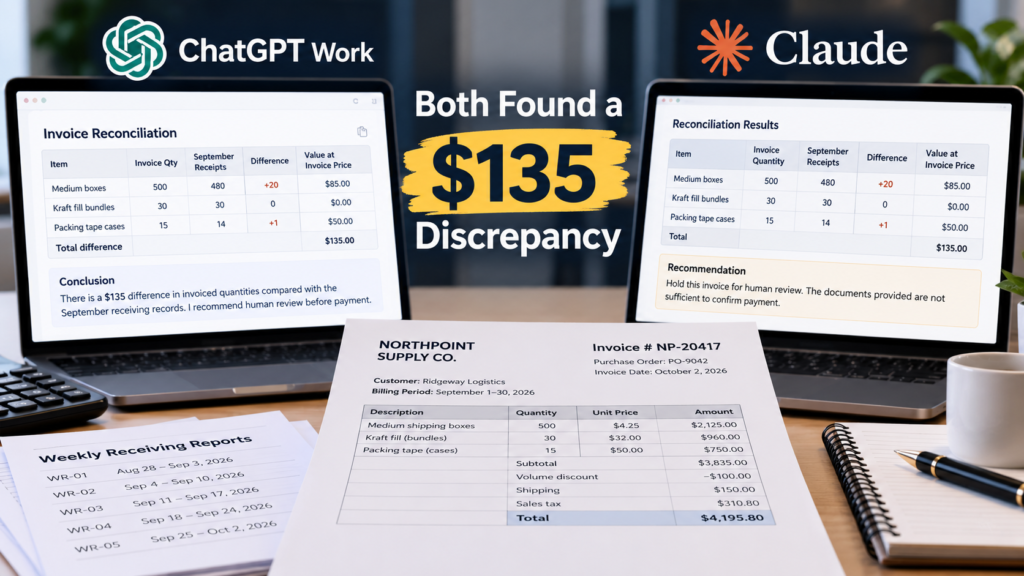
Both found a $135 difference between the invoice and the documented September receipts. More importantly, neither treated that difference as proof of overbilling or recommended approving the invoice.
The interesting part wasn’t the arithmetic. It was how the tools handled dates, duplicated records, and incomplete evidence.
Why I Tested Invoice Reconciliation Instead of Simple Invoice Reading
For a small business, checking an invoice isn’t always as straightforward as multiplying quantities by prices.
A vendor might invoice at the end of the month while warehouse receipts are recorded weekly. A report might include a transaction from the previous month. An export could repeat a receipt already listed elsewhere.
And the invoice itself can still look completely normal.
AI document tools are increasingly useful for reviewing business files. But there’s a difference between reading an invoice and checking whether its charges are supported.
I wanted to see how ChatGPT Work and Claude handled that distinction.
How Our AI Invoice Reconciliation Test Worked
I used a controlled scenario with fictional companies and synthetic documents. No real customer, vendor, or financial transaction was involved.
The invoice, NP-20417, covered September 1–30, 2026, and referenced purchase order PO-9042.
Its total was $4,195.80.
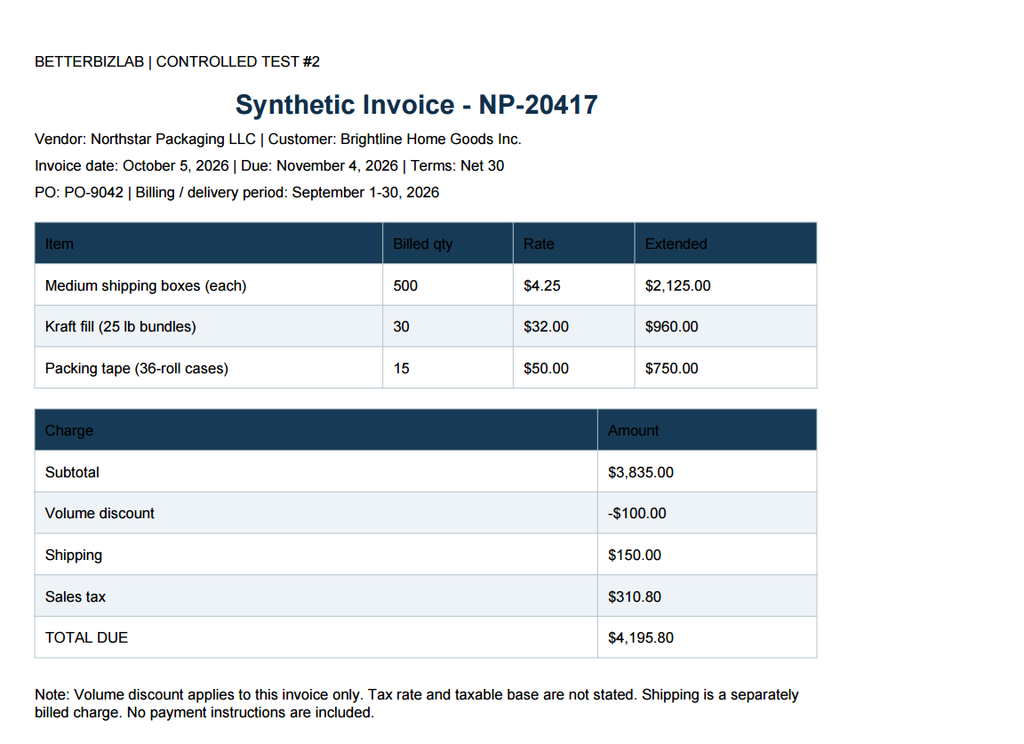
The supporting material consisted of five weekly receiving reports, WR-01 through WR-05. Together, their stated date ranges covered the month of September, although the first report began in August and the last extended into October.
I deliberately included several situations that could cause a reconciliation mistake:
- A receipt dated before the invoice period.
- A receipt dated after the invoice period.
- A receipt ID repeated in two weekly reports.
- A repeated receipt appearing outside one report’s stated coverage dates.
- Invoice quantities that did not match the unique September receipts.
Both AI systems received the same invoice, the same reports, and the same instructions. I did not provide the answer key.
The prompt asked each system to identify date issues, reconcile quantities using receipt IDs, recalculate invoice amounts, quantify differences at invoice prices, and distinguish confirmed findings from questions requiring human review.
This was one controlled test, not a broad benchmark of either platform.
First, Both AI Tools Passed the Easy Part
The invoice’s internal calculations were correct.
| Invoice item | Calculation | Amount |
|---|---|---|
| Medium shipping boxes | 500 × $4.25 | $2,125.00 |
| Kraft fill | 30 × $32.00 | $960.00 |
| Packing tape | 15 × $50.00 | $750.00 |
| Subtotal | Sum of three items | $3,835.00 |
| Volume discount | Stated amount | −$100.00 |
| Shipping | Stated amount | $150.00 |
| Sales tax | Stated amount | $310.80 |
| Total | 3,835 − 100 + 150 + 310.80 | $4,195.80 |
ChatGPT Work and Claude both confirmed the arithmetic.
If I had stopped the test here, the invoice might have looked fine.
But the receiving reports told a different story.
The $135 Difference Both Tools Found
The key question was whether the quantities billed matched the unique receipts dated within September.
Here’s what both AI systems calculated:
| Item | Invoice quantity | September receipts | Difference | Value at invoice price |
|---|---|---|---|---|
| Medium boxes | 500 | 480 | +20 | $85.00 |
| Kraft fill bundles | 30 | 30 | 0 | $0.00 |
| Packing tape cases | 15 | 14 | +1 | $50.00 |
| Total difference | $135.00 |
Both tools found the same two quantity differences: 20 extra boxes and one extra tape case on the invoice compared with the supplied September records.
That $135 is a useful number, but it needs careful wording.
It is the value of the quantity differences using the invoice’s own unit prices. It is not a confirmed overcharge, approved credit, or revised payment amount.
The reports explicitly did not guarantee complete coverage of receiving activity. Missing receipts, other supporting documents, or an agreed billing arrangement could change the final conclusion.
Both systems recognized that limitation.
The Date Problem That Could Have Hidden the Box Difference
This was one of the more revealing parts of the test.
The September receiving records showed 480 boxes.
But WR-01 also contained a receipt for 20 boxes dated August 31.
Add those 20 boxes to September’s 480, and you get exactly 500—the quantity on the invoice.
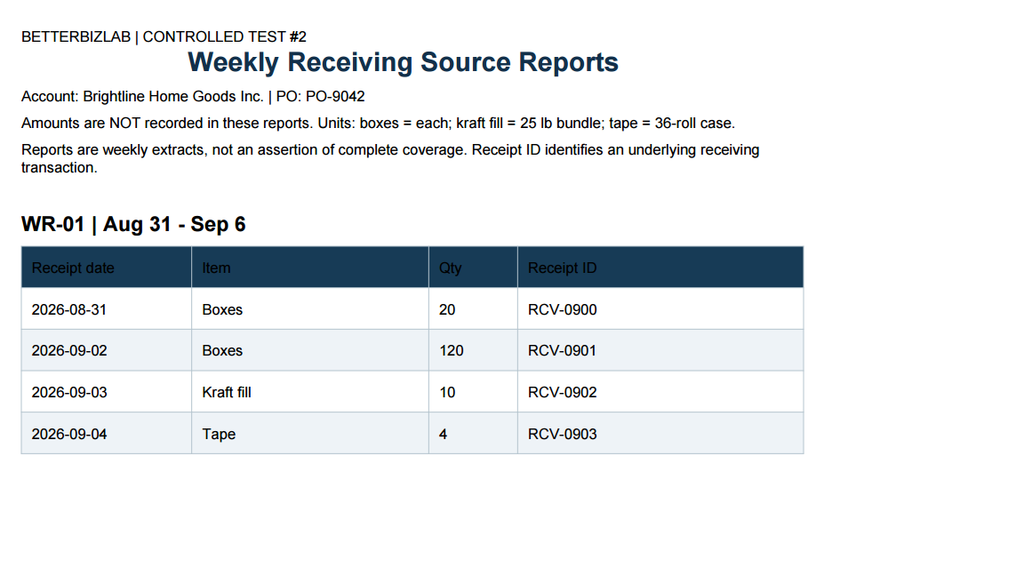
That creates a tempting shortcut: the numbers match, so the invoice must be right.
Except the invoice explicitly covered September 1–30.
Both ChatGPT Work and Claude excluded the August 31 receipt when calculating September quantities.
They also excluded an October 2 receipt for another 40 boxes.
This matters because weekly reports and monthly invoices don’t always line up neatly. A reliable reconciliation needs to inspect the underlying transaction dates, not just the totals printed on each report.
Neither AI could establish why the invoice included 500 boxes. It could only identify the difference and flag the August receipt as a possible explanation requiring investigation.
That’s the appropriate distinction.
The Duplicate Receipt Test
I also included a duplicate transaction.
Receipt RCV-0906 showed five cases of packing tape dated September 11. It appeared in WR-02 and again in WR-03.
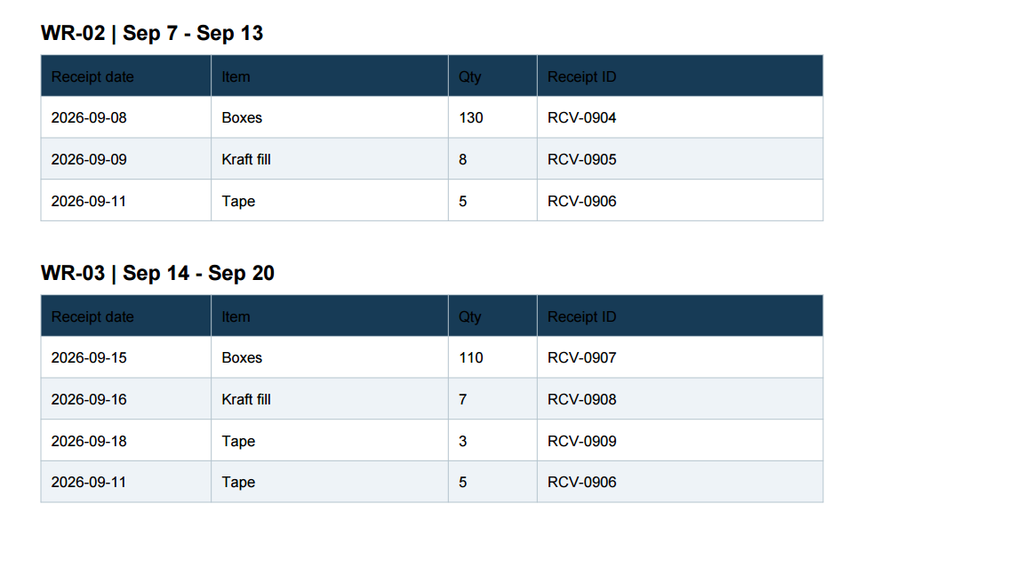
The second appearance was especially suspicious because WR-03 covered September 14–20. A September 11 receipt didn’t belong within that report’s stated range.
Both AI systems spotted the duplicate and counted the underlying receipt only once.
That produced 14 unique September tape cases.
Counting the duplicated record twice would have produced 19 cases, creating another incorrect total.
Claude made an additional useful observation: the invoice billed 15 cases, which didn’t match either the correct unique count of 14 or the duplicate-inflated count of 19.
In other words, the duplicate was a real source-data problem, but it didn’t by itself explain the invoice’s extra tape case.
I liked that distinction because it resisted the urge to turn every discovered anomaly into an explanation.
ChatGPT Work vs Claude: What Was Actually Different?
In this test, neither tool had a meaningful accuracy advantage on the main reconciliation task.
Both found the two quantity differences, identified the repeated receipt, excluded out-of-period transactions, verified the invoice arithmetic, and recommended human review before payment.
Their presentation differed more than their conclusions.
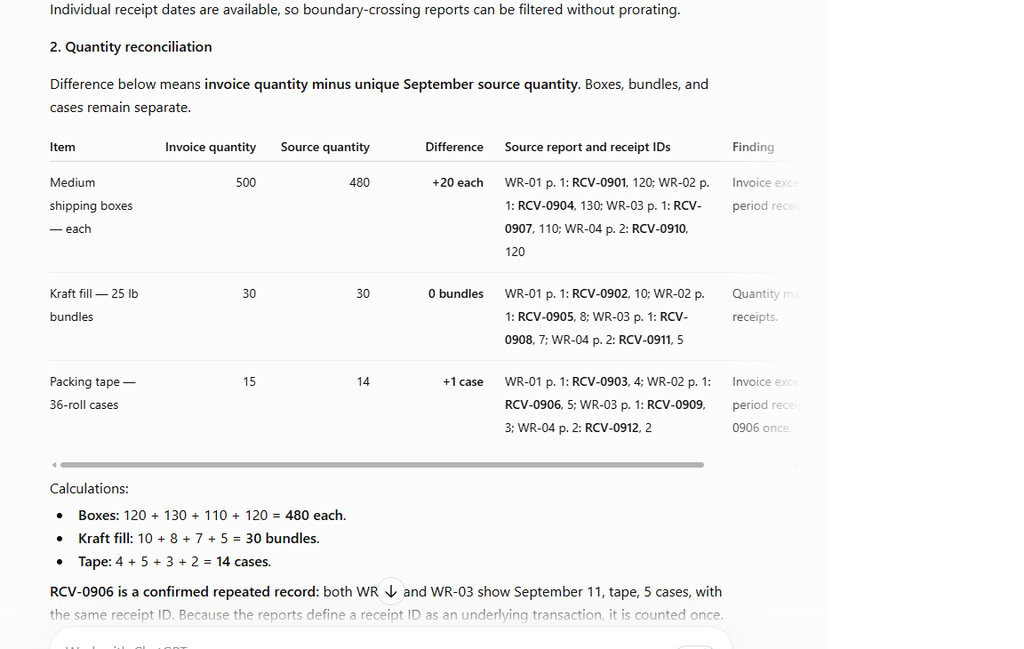
ChatGPT Work identified 20 extra boxes and one extra tape case, totaling a $135 discrepancy at invoice rates. It flagged the differences for human review rather than treating them as confirmed overcharges.
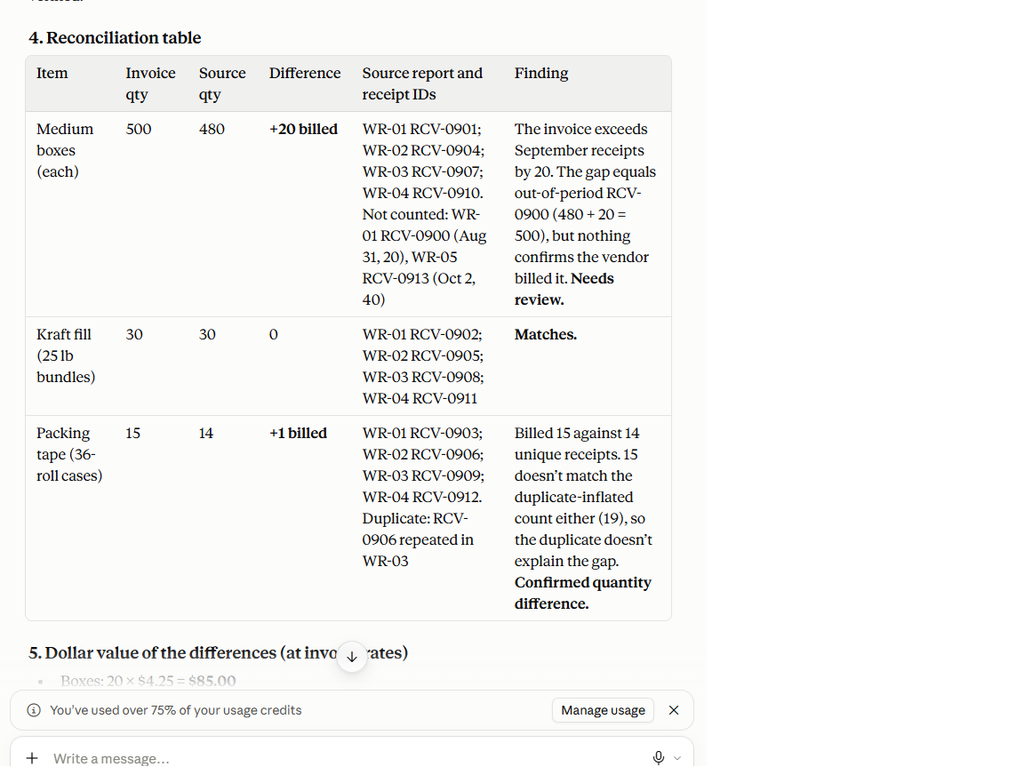
Claude independently found the same $135 discrepancy and detected the duplicate receipt RCV-0906. Like ChatGPT Work, it recommended human review before approving payment.
| Evaluation | ChatGPT Work | Claude |
|---|---|---|
| Invoice arithmetic | Correct | Correct |
| September quantity totals | Correct | Correct |
| Duplicate receipt detection | Found RCV-0906 | Found RCV-0906 |
| Out-of-period receipts | Identified both | Identified both |
| Merchandise difference | $135 | $135 |
| Source-data limitations | Clearly explained | Clearly explained |
| Payment recommendation | Hold for review | Hold for review |
ChatGPT Work produced a particularly structured reconciliation, with report references and receipt IDs that made the calculations easy to follow.
Claude offered a few extra interpretive observations. It explicitly noted that the duplicate-inflated tape quantity still wouldn’t explain the billed quantity. It also noticed that the stated sales tax equaled 8% of a possible taxable base.
Claude did not claim that 8% was the actual tax rate.
That restraint was important. The invoice didn’t establish the applicable tax rules or whether shipping was taxable.
I wouldn’t declare a winner based on those differences. For this specific document set, both delivered a useful first-pass reconciliation.
For a broader look at how these assistants handle everyday business decisions, see our ChatGPT vs Claude comparison for small businesses.
What Neither AI Could Verify
This is where the test becomes relevant to a real business.
Neither tool had the complete receiving ledger, the vendor contract, the approved purchase-order pricing, or the tax documentation.
That left several questions unresolved.
Were there additional September receipts missing from the weekly extracts? Were the invoice’s unit prices contractually correct? Was the $100 volume discount valid? What supported the $150 shipping charge? Was the $310.80 sales tax calculated using the appropriate rate and taxable base?
The models could identify those gaps. They couldn’t close them from the supplied documents.
And they shouldn’t pretend otherwise.
Both recommended holding the invoice for human review rather than treating a mathematically correct total as sufficient evidence for payment.
Where I Would Use AI in a Small Business Invoice Workflow
Based on this test, I see AI as a useful review assistant, particularly when the job involves comparing documents that aren’t organized in exactly the same way.
If you’re considering these tools for business documents, review OpenAI’s official ChatGPT information and Anthropic’s official Claude documentation before deciding which fits your workflow.
A practical workflow would look like this:
Step 1: Gather the evidence. Start with the invoice, purchase order, receiving records, and any applicable pricing or shipping agreement. If a document is missing, make that explicit.
Step 2: Ask for a traceable reconciliation. Require the AI to show invoice quantities, source quantities, receipt IDs, dates, calculations, and differences.
Step 3: Check for data-quality problems. Look for duplicate transaction IDs, mixed units, records outside the billing period, and reports that don’t guarantee complete coverage.
Step 4: Separate findings from assumptions. A $135 discrepancy is a finding. A $135 confirmed overcharge is a different claim and requires stronger evidence.
Step 5: Keep payment decisions with an authorized person. The AI can help prepare an exception report. It should not silently authorize a payment, credit, or change to the vendor’s records.
This is also why I would test any recurring AI reconciliation workflow on a small batch of invoices before trusting it with a larger volume.
A single successful example tells us something about the tool’s potential. It doesn’t establish how consistently it will perform on scanned documents, messy spreadsheets, partial shipments, returns, or complicated tax treatment.
The Prompt I Used
For anyone who wants to try a similar test, this is the structure of the instruction I gave both tools:
Reconcile the attached invoice against the attached weekly receiving reports. Use only the supplied documents. Do not invent missing facts.
Identify the invoice billing period and each report’s coverage dates. Detect overlaps, out-of-period records, and missing coverage.
Reconcile item quantities using receipt IDs to detect possible duplicate transactions. Keep units separate.
Recalculate invoice arithmetic and provide a reconciliation table showing invoice quantities, source quantities, differences, and specific source references.
Calculate the value of quantity differences using invoice prices where possible, but do not assume these are approved overcharges.
Distinguish confirmed discrepancies from missing evidence, assumptions, and issues requiring human review. Explain whether payment can be approved based on the supplied documents.
The important part isn’t any magic phrase. It’s requiring the system to show its evidence and say when that evidence isn’t enough.
Limitations of This Test
There are several reasons not to overstate the result.
First, the documents were synthetic and intentionally designed to contain detectable problems. This made the comparison controlled, but it wasn’t a live accounts-payable environment.
Second, each system was evaluated on one reconciliation scenario. I didn’t run repeated trials or test different prompt styles.
Third, the weekly reports contained receipt IDs and individual transaction dates. That made it possible to identify duplicates and exclude out-of-period transactions. Less structured documents may be harder.
Fourth, the reports did not guarantee complete coverage. Even though both models calculated the same September totals, neither could prove those were all the receipts that existed.
Finally, the test measured document analysis, not end-to-end accounting automation. Neither system was asked to update an ERP, contact a vendor, or execute a payment.
Those limitations don’t make the findings meaningless. They define what the test actually demonstrates.
My Takeaway: Finding a Difference Is Only Half the Job
I expected both tools to handle the multiplication and addition.
What I wanted to know was whether they would catch the problems that make an invoice harder to trust: dates that don’t belong, a transaction that appears twice, and quantities that don’t reconcile even though the total adds up.
In this test, both ChatGPT Work and Claude did that well.
They independently reached the same $135 merchandise difference and avoided calling it a confirmed overcharge. They also recognized that the documents weren’t sufficient to approve payment.
That’s the behavior I’d want from an AI assistant helping a small business review invoices.
Not a tool that confidently says everything is fine.
A tool that can show exactly where the numbers stop agreeing—and tell you what still needs to be checked before anyone pays.