Running a small business often means switching between completely different tasks throughout the day.
One moment you are answering a customer email. The next, you are planning a promotion, researching competitors, preparing for a meeting, or trying to figure out what to post on social media.
ChatGPT can help with many of these tasks—but the quality of the result depends heavily on how you ask.
A vague prompt such as “write a marketing email” may produce a generic response. A prompt that explains your business, audience, objective, tone, and desired output gives ChatGPT much more useful context.
This guide includes 15 practical ChatGPT prompts for small business owners that you can copy, customize, and use for everyday tasks.
If you are still learning the basics, start with our guide on how to use ChatGPT for small business before working through the prompts below.
How to Get Better Results From These ChatGPT Prompts
Before using the prompts, replace the information inside brackets with details about your own business.
For example:
[BUSINESS] = local coffee shop
[CUSTOMER] = first-time customer
[PRODUCT] = cold brew subscription
[GOAL] = increase repeat purchases
[TONE] = friendly and conversational
The more useful context you provide, the less ChatGPT has to guess.
You should also review important facts, numbers, claims, and business decisions before using AI-generated output.
Think of these prompts as starting points for better work—not instructions to blindly copy every response.
1. Write a Professional Customer Email
Small business owners frequently need to respond to inquiries, complaints, requests, and follow-ups.
Instead of starting every email from scratch, give ChatGPT the situation and let it create a first draft.
Copy This Prompt
Act as a professional customer service assistant for [BUSINESS].
Write an email to [CUSTOMER TYPE] regarding [SITUATION].
The goal of the email is to [GOAL].
Include these important details:
[DETAIL 1]
[DETAIL 2]
[DETAIL 3]Use a [TONE] tone.
Keep the email concise, professional, and easy to understand.
Provide a clear subject line and end with an appropriate next step.
Customize it: Tell ChatGPT who the recipient is and what outcome you want instead of simply asking it to “write an email.”
2. Create a Customer Complaint Response
A frustrated customer usually needs a response that acknowledges the problem without making promises your business cannot keep.
Copy This Prompt
Help me respond to the following customer complaint:
[PASTE COMPLAINT]
Business context:
[EXPLAIN WHAT HAPPENED]Write a calm and professional response that:
- Acknowledges the customer’s concern.
- Avoids becoming defensive.
- Clearly explains what we can do.
- Does not promise anything outside our policy.
- Ends with a practical next step.
Use a respectful and human tone.
Customize it: Include your actual refund, return, shipping, or service policy so the response stays within what your business can realistically offer.
3. Generate Social Media Content Ideas
One of the hardest parts of social media is continually deciding what to post.
ChatGPT can help turn one business objective into multiple content ideas.
Copy This Prompt
Act as a social media strategist for [BUSINESS TYPE].
Our target customer is [TARGET AUDIENCE].
Our main product or service is [PRODUCT/SERVICE].
Our current goal is [AWARENESS / ENGAGEMENT / LEADS / SALES].
Generate 15 social media post ideas.
For each idea, provide:
- Topic
- Hook
- Recommended format
- Main message
- Call to action
Avoid repetitive ideas and overly promotional content.
Customize it: Add the platform you are using—such as Instagram, LinkedIn, TikTok, or Facebook—because the same idea may need a different format on each platform.
4. Build a One-Month Content Calendar
Once you have ideas, ChatGPT can help organize them into a realistic publishing schedule.
Copy This Prompt
Create a four-week content calendar for [BUSINESS].
Target audience: [AUDIENCE]
Business goal: [GOAL]
Main topics we want to cover:
[TOPIC 1]
[TOPIC 2]
[TOPIC 3]We can realistically publish [NUMBER] times per week.
Create a table containing:
- Day
- Content topic
- Format
- Opening hook
- Call to action
Balance educational, useful, engaging, and promotional content.
Customize it: Give ChatGPT a realistic publishing frequency. A calendar you can actually maintain is more useful than an ambitious schedule you abandon after a week.
5. Brainstorm a Marketing Promotion
Instead of asking for random marketing ideas, provide constraints such as budget, timing, audience, and business objective.
Copy This Prompt
Act as a small business marketing strategist.
Business: [BUSINESS]
Product/service: [PRODUCT]
Target customer: [CUSTOMER]
Goal: [GOAL]
Promotion period: [TIME PERIOD]
Approximate budget: [BUDGET]
Generate 10 practical promotional ideas.
For each idea, explain:
- The concept.
- Why the customer might respond to it.
- How to execute it.
- Approximate effort required.
- One potential downside.
Prioritize realistic ideas over expensive or complicated campaigns.
Customize it: Include limitations. Constraints often make AI recommendations more useful because they eliminate ideas your business cannot realistically execute.
6. Research Competitors More Systematically
ChatGPT can help create a framework for competitor research, but it should not invent current competitor facts.
Use verified information from company websites, product pages, reviews, or your own research.
Copy This Prompt
Help me analyze the following competitors for [BUSINESS].
Competitor information:
[PASTE VERIFIED INFORMATION]Compare them using:
- Target customer
- Product or service offering
- Pricing position
- Key selling points
- Customer experience
- Marketing message
- Strengths
- Weaknesses
Then identify potential gaps or opportunities for my business.
Clearly separate facts provided by me from your interpretation. Do not invent missing information.
Customize it: Give ChatGPT real source material whenever possible instead of asking it to guess what a competitor currently offers.
7. Define Your Ideal Customer
Many marketing problems begin with an audience that is too broad.
This prompt can help organize what you already know about your customers.
Copy This Prompt
Help me create a practical customer profile for [BUSINESS].
Here is what we currently know:
Typical customer: [DESCRIPTION]
Main problem: [PROBLEM]
Why they buy from us: [REASON]
Common objections: [OBJECTIONS]
Typical budget: [BUDGET]Based only on this information, organize the customer profile into:
- Primary needs
- Buying motivations
- Concerns
- Questions they may ask before purchasing
- Messages likely to resonate
Identify any important information that is still missing instead of making assumptions.
Customize it: Actual customer feedback, sales conversations, reviews, and support questions are much more useful inputs than imaginary demographic details.
8. Improve a Product Description
AI can help turn a list of product features into clearer customer-focused language.
Copy This Prompt
Rewrite the following product description for [TARGET CUSTOMER]:
[CURRENT DESCRIPTION]
Product facts:
[FACTS]Main customer problem it addresses:
[PROBLEM]Desired tone:
[TONE]Create:
- A short product headline.
- A 2–3 sentence description.
- Five benefit-focused bullet points.
- A concise call to action.
Do not add product claims, specifications, certifications, or benefits that are not included in the information I provided.
Customize it: Provide verified product facts. This is especially important for products where unsupported performance, health, or regulatory claims could create problems.
9. Prepare for an Important Meeting
ChatGPT can help organize your thinking before a customer, vendor, partner, or internal meeting.
Copy This Prompt
Help me prepare for a meeting with [PERSON/COMPANY].
Meeting objective:
[OBJECTIVE]Background:
[CONTEXT]Important issues:
[ISSUES]Desired outcome:
[OUTCOME]Create:
- Five questions I should ask.
- Three points I should communicate clearly.
- Potential objections or concerns.
- Information I should prepare in advance.
- A simple meeting agenda.
- Recommended next steps after the meeting.
Flag any assumptions you are making.
Customize it: Paste relevant notes from previous conversations or meetings when appropriate.
10. Turn Meeting Notes Into Action Items
Meeting notes are useful only if someone knows what needs to happen next.
Copy This Prompt
Organize the following meeting notes:
[PASTE NOTES]
Produce:
- A short meeting summary.
- Key decisions.
- Action items.
- Person responsible for each action, only if explicitly stated.
- Deadlines, only if explicitly stated.
- Open questions.
- Items requiring follow-up.
Do not invent owners or deadlines when they are missing. Label them as “TBD.”
Customize it: This prompt is particularly useful when your notes contain a mixture of decisions, ideas, questions, and unrelated discussion.
11. Create a Simple SOP
Standard operating procedures can reduce the amount of knowledge that exists only in one person’s head.
Copy This Prompt
Help me create a simple standard operating procedure for:
[PROCESS]
Here is how we currently perform the task:
[DESCRIBE PROCESS]
Organize it into:
- Purpose
- When this procedure should be used
- Person or role responsible
- Required tools or information
- Step-by-step procedure
- Quality-control checks
- Common mistakes
- Escalation points
Keep the instructions clear enough for a new employee to follow.
If any important step is unclear or missing, ask me instead of inventing the process.
Customize it: Start with a process you already understand well. AI should organize your workflow—not create critical operational procedures from guesses.
12. Find Repetitive Tasks That May Be Automated
Before buying automation software, identify where your team repeatedly performs predictable manual work.
Copy This Prompt
Act as a small business workflow analyst.
Here are recurring tasks in my business:
[LIST TASKS]
Analyze each task and classify it as:
- Keep manual
- AI-assisted
- Potentially automatable
- Needs further review
For tasks that may be automated, explain:
- What part could potentially be automated.
- What information or systems would be required.
- What should still be reviewed by a human.
- Potential risks or failure points.
Prioritize simple, low-risk improvements before complex automation.
Customize it: Include how often each task occurs and approximately how much time it takes. That helps identify which improvements may have the highest practical value.
13. Analyze Customer Reviews
Customer reviews can reveal repeated themes that are easy to miss when reading them individually.
Copy This Prompt
Analyze the following customer reviews:
[PASTE REVIEWS]
Identify:
- Most common positive themes
- Most common complaints
- Frequently mentioned product/service features
- Customer expectations
- Repeated questions or confusion
- Potential opportunities for improvement
Include representative themes, but do not change the meaning of what customers said.
Finish with five practical actions the business could investigate.
Customize it: Use a meaningful sample rather than selecting only your best or worst reviews.
14. Create a Weekly Business Review
ChatGPT can also help structure a regular review of what happened in your business.
Copy This Prompt
Help me conduct a weekly review for my small business.
Here is this week’s information:
Sales/results: [DATA]
Marketing: [DATA]
Customer feedback: [DATA]
Operations: [DATA]
Problems encountered: [DATA]
Important upcoming events: [DATA]Organize the review into:
- What went well.
- What underperformed.
- Important changes from the previous period, if comparison data is provided.
- Problems requiring attention.
- Three priorities for next week.
- Questions I should investigate.
Do not infer trends when there is not enough data.
Customize it: Using the same format every week makes the output more comparable over time.
15. Turn a Business Goal Into an Action Plan
Large goals often fail because they are not converted into specific actions.
Copy This Prompt
Act as a practical business planning assistant.
My goal is:
[GOAL]Current situation:
[CURRENT STATE]Deadline:
[DEADLINE]Available resources:
[RESOURCES]Main constraints:
[CONSTRAINTS]Break the goal into:
- Key milestones
- Actions for the next 30 days
- Weekly priorities
- Metrics to track
- Potential obstacles
- Decisions that require human judgment
Prioritize the actions by impact and feasibility.
If the goal appears unrealistic based on the information provided, explain why instead of forcing a plan.
Customize it: The more honest you are about budget, time, staffing, and other constraints, the more realistic the plan can become.
A Simple ChatGPT Prompt Formula for Small Business
You do not need to memorize dozens of prompts.
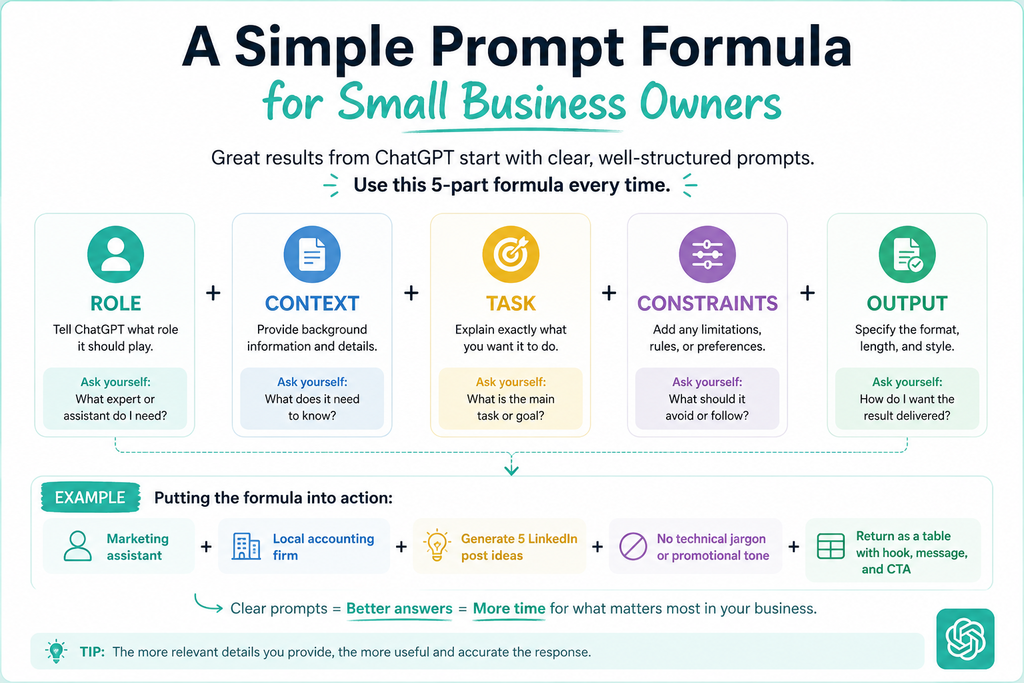
A useful business prompt usually contains five things:
Role + Context + Task + Constraints + Output
For example:
Act as a marketing assistant for a local accounting firm.
We serve small businesses with fewer than 20 employees.
Generate five educational LinkedIn post ideas about common bookkeeping mistakes.
Avoid technical jargon and direct sales pitches.
Return the ideas in a table with a hook, key message, and call to action.
This gives ChatGPT far more direction than:
Give me some LinkedIn ideas.
Once you understand this structure, you can build prompts for many different business situations.
Should You Use ChatGPT for Every Business Task?
No.
AI can help with drafting, summarizing, brainstorming, organizing, and analyzing information, but some decisions require professional expertise or human judgment.
Be particularly careful with legal, tax, financial, employment, medical, regulatory, security, and other high-stakes matters.
Verify important facts and calculations, protect confidential information, and review AI-generated work before using it with customers, employees, or business partners.
ChatGPT should help you work more efficiently—not remove accountability from important decisions.
ChatGPT or Claude for Business?
ChatGPT is not the only AI assistant available.
Depending on the task, another AI platform may be useful—particularly when working with long documents or comparing different approaches to the same problem.
If you are deciding which platform fits your workflow, read our ChatGPT vs Claude for small business comparison.
Using more than one AI can also be useful for important work. For example, one tool can generate an initial plan while another critiques the assumptions and identifies weaknesses.
Final Thoughts
The best ChatGPT prompts for small business are not necessarily the longest or most complicated.
They are the prompts that give AI enough context to understand:
what you are trying to accomplish, who the work is for, what constraints matter, and what a useful result should look like.
Start with one of the prompts above and adapt it to a real task you already perform.
If it saves time while maintaining quality, keep improving the workflow.
Then move to the next repetitive task.
Over time, a small collection of well-designed prompts can become a practical operating toolkit for your business—without requiring dozens of AI apps or complicated automation systems.