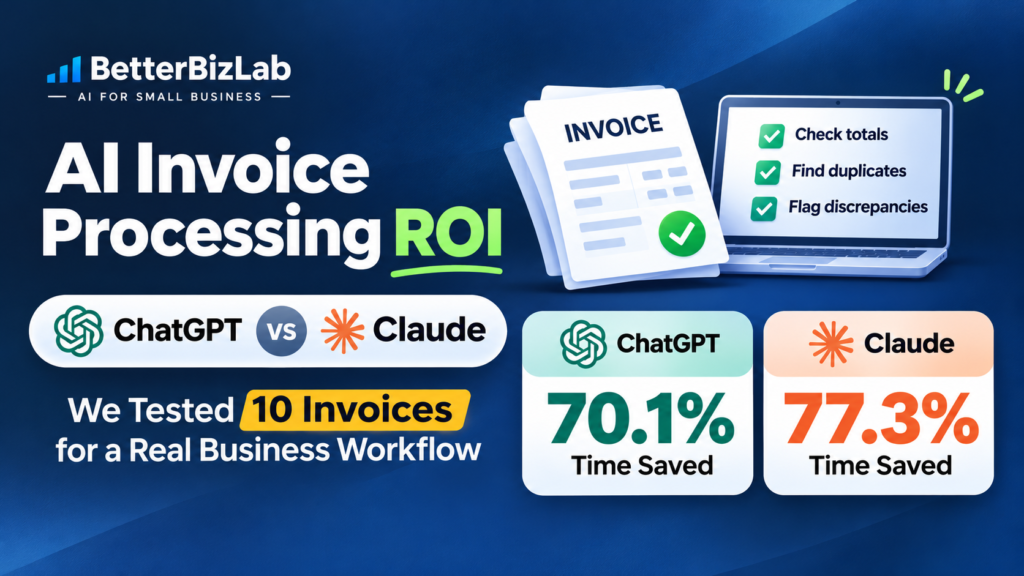
AI invoice processing ROI depends on more than how quickly an AI tool reads an invoice. We tested ChatGPT and Claude on 10 synthetic supplier invoices, measured the time required for human review, and calculated the potential labor savings for a small business.
The surprising result wasn’t which AI answered faster. It was which one required less work afterward.
ChatGPT generated its invoice audit in 22 seconds. Claude took 41 seconds. But once we included human verification, Claude finished the complete workflow nearly three minutes sooner.
In our controlled BetterBizLab test, ChatGPT reduced total processing time by 70.1%, while Claude reduced it by 77.3%, compared with our manually completed baseline.
Those are measured time reductions from one small experiment—not guaranteed savings for every business. To understand whether AI invoice processing is financially worthwhile, we also need to account for software costs, employee time, setup expenses, and the invoices that still require human judgment.
What We Actually Tested
We created ten synthetic supplier invoices designed to resemble the documents a small-business accounts payable team might receive.
Five invoices contained intentional problems, while the other five served as normal examples.
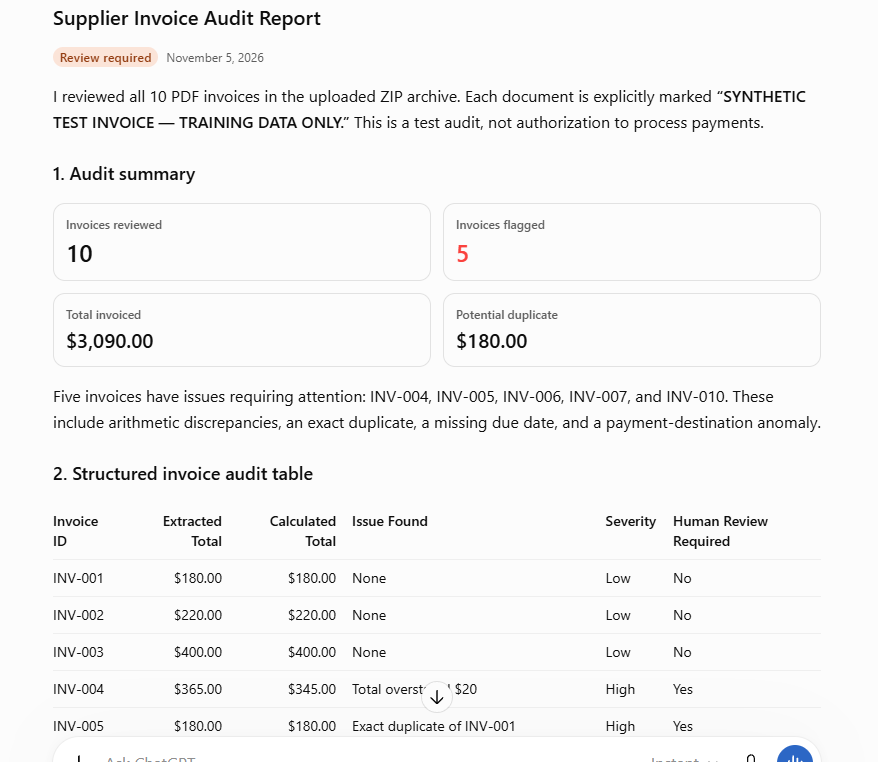
Our hands-on ChatGPT test identified five invoices requiring review in a batch of 10 synthetic supplier invoices.
The test included an overstated invoice total, a duplicate invoice, a missing due date, an incorrect tax calculation, and a supplier payment-destination change.
We also included a correctly calculated discount and a multi-line invoice to see whether the models could handle ordinary accounting details without confusing them with actual errors.
Every document was clearly labeled as synthetic training data. We did not upload confidential supplier records, authorize payments, or modify accounting systems.
We asked ChatGPT and Claude to extract key invoice fields, recalculate totals, identify possible duplicates, flag discrepancies, and explain which items required human review.
Both models received the same ten invoice PDFs and audit instructions.
The initial test did not include a separate historical payment database or independently verified supplier master file. That matters: a model can identify an unusual bank account compared with another invoice, but it cannot authenticate the account’s ownership from those documents alone.
Our Three Timed Workflows
We measured three different approaches:
Manual processing: A person reviewed and processed the ten synthetic invoices without AI assistance.
ChatGPT-assisted processing: ChatGPT generated an initial audit, followed by a human review of the output.
Claude-assisted processing: Claude generated an initial audit, followed by a human review of the output.
For the AI-assisted workflows, total time included both the AI response and the subsequent human review.
The purpose was to compare the time required to produce a reviewed audit report—not to measure end-to-end invoice approval, ERP posting, or payment execution.
BetterBizLab Test Results: Manual vs ChatGPT vs Claude
| Measurement | Manual | ChatGPT | Claude |
|---|---|---|---|
| Invoices reviewed | 10 | 10 | 10 |
| Initial AI response | — | 22 sec | 41 sec |
| Human processing or review | 39 min 12 sec | 11 min 22 sec | 8 min 12 sec |
| Total workflow time | 39 min 12 sec | 11 min 44 sec | 8 min 53 sec |
| Time saved vs manual | — | 27 min 28 sec | 30 min 19 sec |
| Time reduction | — | 70.1% | 77.3% |
All three workflows were timed once. These results describe this specific test and should not be treated as a statistically reliable model benchmark.
Finding 1: ChatGPT Responded Faster
ChatGPT produced its initial audit in 22 seconds, compared with Claude’s 41 seconds.
That made ChatGPT approximately 46% faster at generating the first response.
If we had stopped the experiment there, ChatGPT would have appeared to be the clear winner.
But accounts payable work doesn’t end when an AI produces a table.
Someone still needs to check the extracted information, understand flagged discrepancies, and decide what requires further investigation.
Finding 2: Claude Required Less Human Review Time
Reviewing the ChatGPT report took 11 minutes and 22 seconds.
Reviewing Claude’s report took 8 minutes and 12 seconds.
That difference outweighed ChatGPT’s 19-second advantage in initial response speed.
Including both generation and review, Claude completed the measured workflow in 8 minutes and 53 seconds, compared with ChatGPT’s 11 minutes and 44 seconds.
Claude was 2 minutes and 51 seconds faster across the complete ten-invoice workflow.
This does not prove Claude will always require less verification. The test involved one batch, one run per tool, and one measured review workflow per result.
However, it illustrates an important purchasing principle:
The fastest AI response is not necessarily the least expensive AI-assisted workflow.
A business should measure how much work remains after the model finishes—not just how quickly the model responds.
Did Both AI Models Find the Invoice Errors?
Both ChatGPT and Claude identified all five intentionally problematic invoices.
| Invoice | Designed test condition | ChatGPT | Claude |
|---|---|---|---|
| INV-004 | Invoice total overstated by $20 | Detected | Detected |
| INV-005 | Duplicate of INV-001, totaling $180 | Detected | Detected |
| INV-006 | Missing due date | Detected | Detected |
| INV-007 | Tax overstated by $5 under the stated rate | Detected | Detected |
| INV-010 | Different supplier payment destination | Flagged | Flagged |
Both models also recognized that the duplicate invoice and bank-account discrepancy required human follow-up rather than automatic payment approval.
There were differences in how they presented their findings.
ChatGPT flagged five invoices for review. Claude flagged seven, including both documents in the duplicate pair and an additional request to verify the $60 discount on INV-008.
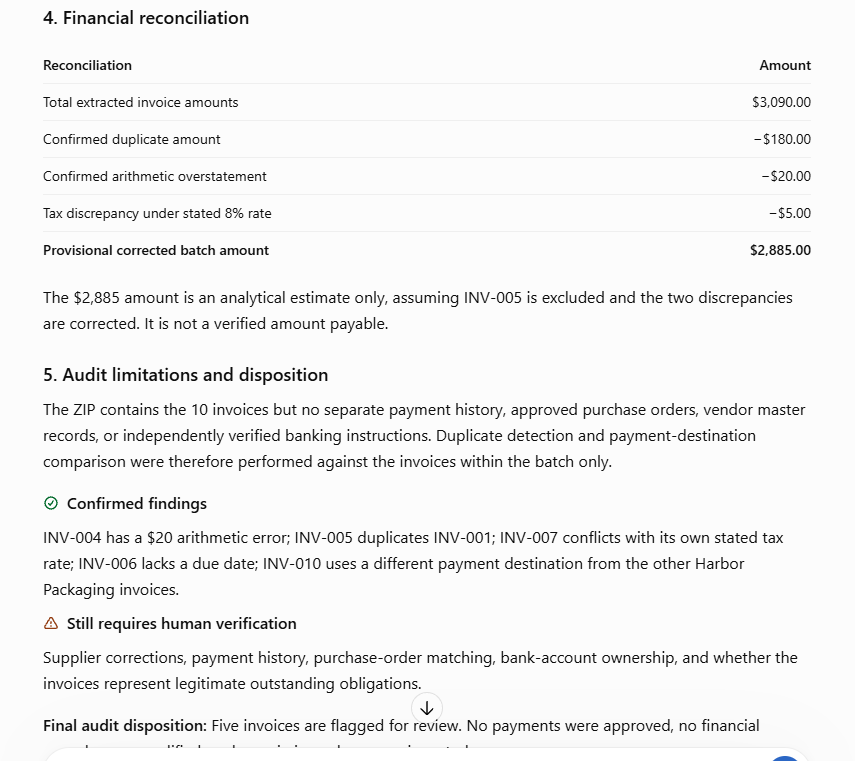
ChatGPT calculated a provisional corrected batch amount of $2,885, subject to human verification.
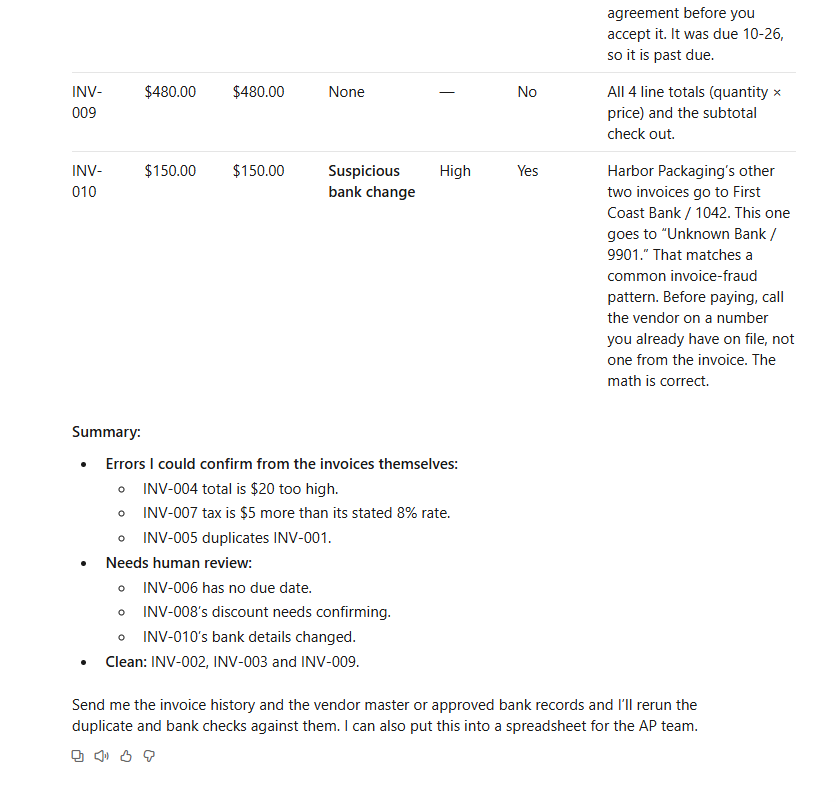
Claude’s invoice-by-invoice review of the same synthetic test batch, including discrepancy explanations and human-review flags.
The discount was mathematically correct and was not one of our intentionally planted errors. Claude’s additional review request was therefore a more conservative accounting judgment, not evidence that the discount itself was wrong.
Whether that extra check is desirable depends on the business’s policies.
A company that requires every supplier discount to match a purchase order might consider it appropriate. A team performing only arithmetic and duplicate checks might see it as unnecessary additional work.
What the Test Does—and Doesn’t—Prove
Both models achieved 5/5 detection of the deliberately designed problem cases in this batch.
That is not the same as proving 100% field-extraction accuracy, a 100% fraud-detection rate, or a zero-error production system.
We did not independently score every extracted field against a complete field-level answer key, and neither model had access to a verified vendor master or payment history.
Most importantly, flagging a changed bank reference is not the same as confirming fraud.
For real invoices, a payment-detail change should be verified through an established supplier contact and the company’s approval process.
How Much Time Did AI Actually Save Per Invoice?
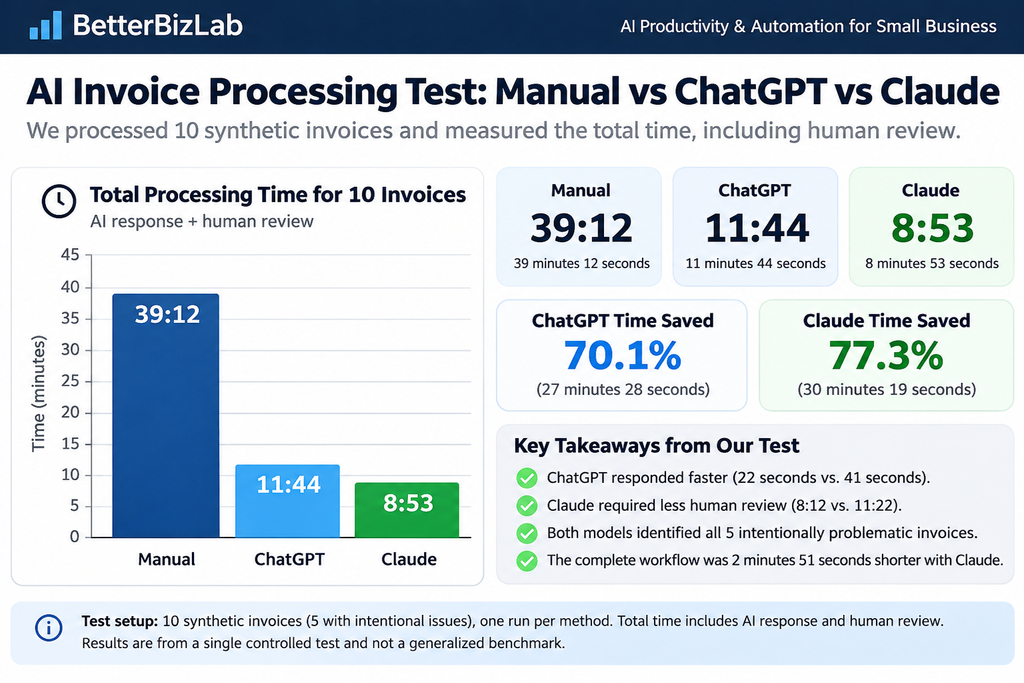
BetterBizLab’s measured end-to-end processing times for 10 synthetic invoices, including human review.
Our measured manual baseline was 39 minutes and 12 seconds for ten invoices.
That equals an average of 3 minutes and 55.2 seconds per invoice.
For ChatGPT, the complete reviewed workflow averaged 1 minute and 10.4 seconds per invoice.
For Claude, it averaged 53.3 seconds per invoice.
| Metric | Manual | ChatGPT | Claude |
|---|---|---|---|
| Average time per invoice | 235.2 sec | 70.4 sec | 53.3 sec |
| Average time saved per invoice | — | 164.8 sec | 181.9 sec |
| Percentage reduction | — | 70.1% | 77.3% |
These averages come from dividing one batch’s total time by ten. They are not separate timing observations for individual invoices.
They also exclude additional real-world tasks such as supplier callbacks, purchase-order matching, accounting-system posting, and final payment approval.
For a small business, those exclusions matter because the most expensive invoice may be the one that triggers a complicated exception—not the one that takes the longest to extract.
Calculate Your AI Invoice Processing ROI
The correct starting point is the amount of staff time saved after human review.
Use this formula:
Time saved per invoice = Manual processing time − AI-assisted processing time
Then calculate the monthly value of that time:
Monthly labor capacity value = Time saved per invoice × Monthly invoice volume × Loaded hourly labor rate
Make sure the time is expressed in hours.
Finally, include the costs of the AI-assisted workflow:
First-year ROI = (First-year labor capacity value − First-year incremental costs) ÷ First-year incremental costs × 100
Incremental costs can include software subscriptions, implementation, training, additional validation, integration work, and exception handling not already included in the measured workflow.
For financial decisions, distinguish between employee capacity recovered and actual payroll expenses reduced. Saving staff time does not automatically reduce cash spending.
Example: A Small Business Processing 150 Invoices Per Month
Let’s apply our measured processing times to a hypothetical small business.
Assume the company processes 150 invoices monthly and values employee time at a loaded labor rate of $30 per hour.
We are using the observed ten-invoice timing averages, but the monthly volume and labor rate are hypothetical assumptions.
| Monthly projection | Manual | ChatGPT | Claude |
|---|---|---|---|
| Invoice volume | 150 | 150 | 150 |
| Estimated processing hours | 9.80 | 2.93 | 2.22 |
| Estimated hours saved | — | 6.87 | 7.58 |
| Estimated labor capacity value | — | $206.00 | $227.38 |
At 150 invoices per month, ChatGPT would recover approximately 6 hours and 52 minutes of employee time.
Claude would recover approximately 7 hours, 34 minutes, and 45 seconds.
At the assumed $30 loaded hourly rate, those savings represent approximately $206 and $227.38 in monthly labor capacity value, respectively.
These projections assume similar invoice complexity, review practices, and performance at higher volume. Actual results may differ.
Now Include the Software Cost
Suppose the business incurs $120 per month in incremental software costs and $360 in one-time setup and training expenses.
These are illustrative budget assumptions, not verified prices for ChatGPT or Claude.
The first-year incremental cost would be:
($120 × 12) + $360 = $1,800
Using our measured workflow times and hypothetical operating assumptions:
| First-year ROI model | ChatGPT | Claude |
|---|---|---|
| Annual labor capacity value | $2,472.00 | $2,728.50 |
| Annual subscription assumption | $1,440.00 | $1,440.00 |
| One-time setup assumption | $360.00 | $360.00 |
| Total first-year cost | $1,800.00 | $1,800.00 |
| Net first-year capacity value | $672.00 | $928.50 |
| Modeled first-year ROI | 37.3% | 51.6% |
Under these assumptions, both workflows have positive modeled ROI.
Claude produces a higher modeled return because its measured end-to-end processing time was shorter.
However, this is not a claim that either model generates these financial returns in production. We have not established real subscription allocation, integration costs, payroll savings, or repeatable performance across a representative invoice population.
If the company already pays for an AI subscription and has spare usage capacity, the incremental software cost could be lower. If it needs an enterprise AP platform, specialized integrations, or substantial security controls, the cost could be higher.
The right comparison uses the additional costs actually caused by adopting the workflow.
What Happens When Exception Handling Costs More?
A common mistake is to assume that every invoice can be processed at the same speed.
In reality, a clean invoice and an invoice with suspicious bank details require different amounts of attention.
For example, suppose the company incurs an additional $75 per month in exception-handling labor or services beyond the review time already included in our test.
This adds $900 per year.
The revised first-year cost becomes:
$1,800 + $900 = $2,700
| Model with extra exception costs | ChatGPT | Claude |
|---|---|---|
| Annual labor capacity value | $2,472.00 | $2,728.50 |
| First-year total cost | $2,700.00 | $2,700.00 |
| Net first-year value | −$228.00 | $28.50 |
| Modeled ROI | −8.4% | 1.1% |
A relatively modest increase in exception-handling costs changes the business case dramatically.
That is why an AI vendor’s advertised extraction speed or accuracy is not enough to establish ROI.
The more useful questions are how often invoices require intervention, how long those interventions take, and which existing accounting controls must remain in place.
Do not double-count the same review time as both part of the AI-assisted processing time and a separate exception expense. Additional costs should represent genuinely additional work.
Break-Even Volume: How Many Invoices Do You Need?
A company processing only a few invoices each month may not recover enough employee time to justify a new paid system.
Using our example’s $30 hourly labor rate, the measured time savings are worth approximately:
ChatGPT: $1.37 per invoice.
Claude: $1.52 per invoice.
If monthly software costs are $120, the approximate ongoing break-even volumes are:
ChatGPT: 88 invoices per month.
Claude: 80 invoices per month.
These figures exclude the one-time setup cost and assume all recovered time has the modeled economic value.
Including the $360 setup expense across the first year increases the effective monthly cost to $150, raising the first-year break-even volumes to approximately 110 invoices for ChatGPT and 99 for Claude.
These thresholds are model outputs, not minimum invoice volumes recommended by either AI provider.
When AI Invoice Processing May Not Be Worth It
AI is not automatically a good investment for every small business.
If a company handles only a handful of simple invoices each month, manual processing may already be efficient.
If invoices are highly irregular, require frequent supplier disputes, or depend on missing purchase orders, the review workload can eliminate much of the expected time savings.
Businesses with strict data-security or compliance requirements must also evaluate whether the chosen tool and configuration are approved for their financial documents.
And if a team needs automatic accounting-system integration, invoice approval routing, audit logs, and payment controls, a general-purpose chatbot may not be a complete solution.
ChatGPT and Claude can help interpret documents and prepare structured analysis. They should not be treated as replacements for an approved accounts payable system or its authorization controls.
A Practical Workflow for Small Businesses
Start by collecting a representative batch of invoices that can be tested safely, using synthetic or properly anonymized documents when evaluating general-purpose AI tools.
Measure how long your team takes to process the batch manually.
Next, have the AI extract vendor names, invoice numbers, dates, amounts, payment terms, and other required fields. Ask it to recalculate totals and identify discrepancies without approving any payment.
Compare the AI output with the original invoices. Record corrections, false alarms, and the time spent verifying each report.
If possible, run a second test with approved vendor records, purchase orders, and historical invoices in a properly authorized environment. This makes it possible to evaluate duplicate detection and supplier changes against independent reference information rather than just the current batch.
Keep payment approval, bank-detail changes, and accounting-system posting under established controls.
Public-sector accounts payable guidance also recommends duplicate-payment screening and vendor-master controls, reinforcing why invoice extraction alone is not a sufficient payment safeguard.
For a step-by-step implementation, read our guide to automating invoice processing with AI.
If you’re comparing dedicated software rather than general-purpose AI assistants, see our AI invoice processing software comparison.
For a closer look at how the two models handle invoice discrepancies, read our ChatGPT vs Claude invoice reconciliation test.
Our Verdict: Is AI Invoice Processing Worth It?
Our controlled test showed meaningful reductions in the time required to produce and review a ten-invoice audit report.
ChatGPT reduced measured processing time by 70.1%.
Claude reduced it by 77.3%.
Both models identified the five deliberately planted anomaly cases, although they differed in how broadly they requested human review.
The most useful discovery was that ChatGPT’s faster initial response did not translate into the fastest complete workflow. Claude’s longer generation time was more than offset by shorter measured human review.
For a small business, that distinction matters more than a few seconds of AI response time.
Our financial model suggests AI-assisted invoice processing can be worthwhile at sufficient volume, but the return is sensitive to software costs, exception handling, and whether recovered employee time produces genuine economic value.
BetterBizLab’s conclusion: Measure the complete reviewed workflow first. Calculate ROI second. Keep payment authority and supplier verification with the people and systems responsible for them.
Frequently Asked Questions
How much time can AI save on invoice processing?
In BetterBizLab’s single ten-invoice synthetic test, ChatGPT reduced the measured workflow time by 70.1%, and Claude reduced it by 77.3%. These are specific experimental observations, not universal savings benchmarks.
Is ChatGPT or Claude better for invoice processing?
Both detected the five intended problem cases in our test. ChatGPT generated its initial report faster, but Claude completed the measured generation-plus-review workflow sooner. A larger test is needed to establish whether the difference is repeatable.
Can AI automatically approve invoices?
An AI-generated audit should not be treated as payment authorization. Supplier verification, required approvals, accounting controls, and payment release should remain within authorized business processes.
How do I calculate AI invoice processing ROI?
Measure manual processing time and AI-assisted processing time including human review. Multiply the time difference by invoice volume and the loaded labor rate, then subtract incremental software, implementation, and exception costs. Divide the resulting net value by the incremental costs.
Does time saved automatically mean money saved?
No. Employees may use recovered time for other work without any reduction in payroll. That creates capacity value, which should be distinguished from realized cash savings.
How many invoices per month justify AI automation?
There is no universal threshold. In our illustrative $120-per-month software-cost scenario, the ongoing break-even volumes were approximately 88 invoices for ChatGPT and 80 for Claude. Actual thresholds depend on your costs and verified workflow savings.