Can AI agents handle a real small-business inventory planning task? We tested ChatGPT Work and Claude Cowork using the same 30-product dataset, identical instructions, and independently prepared reference calculations.
AI agents are moving beyond answering questions. They’re increasingly being used to analyze files, execute multistep workflows, and produce business deliverables.
For small-business owners, however, the question isn’t simply whether an AI agent can generate an impressive-looking report.
Can it produce accurate, actionable work without constant human intervention?
At BetterBizLab, we put two AI agent environments to the test: ChatGPT Work and Claude Cowork.
We gave both agents the same synthetic inventory dataset representing a small skincare distribution company. Their job was to analyze inventory levels, identify stockout risks, calculate purchasing requirements, and deliver a usable Excel report.
The result: Both agents reached the same core purchasing recommendations. ChatGPT Work finished faster, while Claude Cowork produced a more extensively organized report.
Here’s exactly how we tested them, what they delivered, and what the results mean for small businesses.
Quick Verdict: ChatGPT Work vs Claude Cowork
| Test Metric | ChatGPT Work | Claude Cowork |
|---|---|---|
| Products analyzed | 30 SKUs | 30 SKUs |
| SKUs with valid data | 25 | 25 |
| Stockout-risk SKUs | 9 | 9 |
| Products recommended for ordering | 18 | 18 |
| Recommended purchasing quantity | 4,808 units | 4,808 units |
| Estimated purchasing cost | $36,309.72 | $36,309.72 |
| Data exceptions held for review | 5 | 5 |
| Completion time | 2 minutes | 3 minutes |
| Additional human interventions | 0 | 0 |
| Excel report delivered | Yes | Yes |
Our verdict: The agents tied on the main inventory calculations. ChatGPT Work had the speed advantage in this run, while Claude Cowork provided a more detailed workbook structure for purchasing review.
This was one controlled experiment, not a comprehensive benchmark of either platform.
1. Why We Tested AI Agents on Inventory Management
Inventory management is a practical challenge for small distributors, retailers, and e-commerce businesses.
Ordering too much ties up working capital. Ordering too little can cause stockouts, delayed deliveries, and lost sales.
A small company may need to review dozens or hundreds of products while considering sales velocity, current inventory, supplier lead times, minimum order quantities, and incoming purchase orders.
Traditional spreadsheets can handle the calculations, but employees still need to interpret the results, identify exceptions, and prepare purchasing recommendations.
This makes inventory planning an interesting test of AI agent capabilities.
We wanted to answer three questions:
- Can an AI agent apply defined inventory rules accurately?
- Can it recognize missing or unreliable data rather than invent answers?
- Can it turn raw spreadsheet data into a useful business deliverable without additional human instructions?
We chose ChatGPT Work and Claude Cowork because both support multistep work involving files and business documents.
For broader guidance on implementing AI in day-to-day operations, see our small business AI automation guide.
2. Our Testing Methodology: How We Kept the Comparison Fair
Both agents were tested in their respective work environments: ChatGPT from OpenAI and Claude from Anthropic. The comparison focuses on their performance in our specific inventory challenge, not their overall capabilities.
This independent BetterBizLab experiment was conducted on October 16, 2026.
We created a synthetic dataset representing a small skincare distributor with 30 products.
The file contained:
- Product SKU and description
- Current inventory
- Sales over the previous 30 days
- Supplier lead time
- Minimum order quantity (MOQ)
- Product unit cost
- Open purchase order information
- Selected missing, invalid, or uncertain values
The dataset was fictional and contained no confidential customer or supplier information.
Identical inputs and instructions
Both ChatGPT Work and Claude Cowork received the same Excel input file and standardized English prompt.
We instructed both agents to:
- Calculate average daily demand using the previous 30 days of sales.
- Calculate reorder points based on supplier lead times.
- Calculate target inventory levels.
- Account for eligible incoming purchase orders.
- Recommend order quantities rounded to MOQ multiples.
- Flag missing, invalid, or uncertain data.
- Produce an Excel purchasing report with calculations, priorities, costs, and an executive summary.
Neither agent received the other agent’s results.
Independent reference calculations
Before comparing the outputs, we prepared a separate reference workbook containing the expected calculations and data-quality exceptions.
Neither agent received this answer key.
We compared the reported purchasing results against the reference calculations to evaluate accuracy.
Test conditions
| Condition | ChatGPT Work | Claude Cowork |
|---|---|---|
| Input dataset | Identical | Identical |
| Calculation instructions | Identical | Identical |
| Reference answers supplied | No | No |
| Additional human interventions | 0 | 0 |
| Measured executions | 1 | 1 |
| Required output | Excel workbook | Excel workbook |
Both agents were explicitly instructed not to place purchase orders, send emails, or modify external systems.
How the inventory calculations worked
We used the following formulas.
Average daily demand
Average Daily Demand = Last 30 Days Sales / 30
Reorder point
Reorder Point = Average Daily Demand × Supplier Lead Time
Target inventory
Target Inventory = Reorder Point + 30 Days of Demand
Recommended order quantity
Required Quantity = MAX(0, Target Inventory − On-Hand Stock − Eligible Incoming Stock)
The required quantity was then rounded up to the appropriate supplier MOQ multiple.
Incoming purchase orders were counted only when their expected arrival was known and fell within the specified lead-time window.
These rules were provided to both agents before testing.
We did not add safety stock, seasonality adjustments, or demand forecasting beyond the defined formulas.
Timing and intervention tracking
ChatGPT Work completed the assignment in approximately two minutes.
Claude Cowork completed it in approximately three minutes.
Neither required additional human instructions after receiving the initial prompt.
These were user-observed completion times, not automated performance benchmarks.
3. Results: Both Agents Recommended the Same Purchases
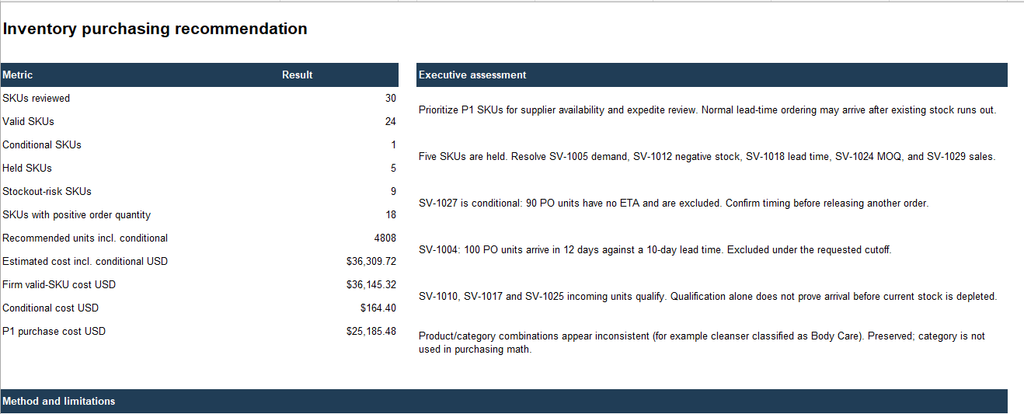
Figure 1. ChatGPT Work’s actual inventory purchasing summary from our 30-SKU test, identifying nine stockout-risk products and recommending 4,808 units at an estimated cost of $36,309.72.
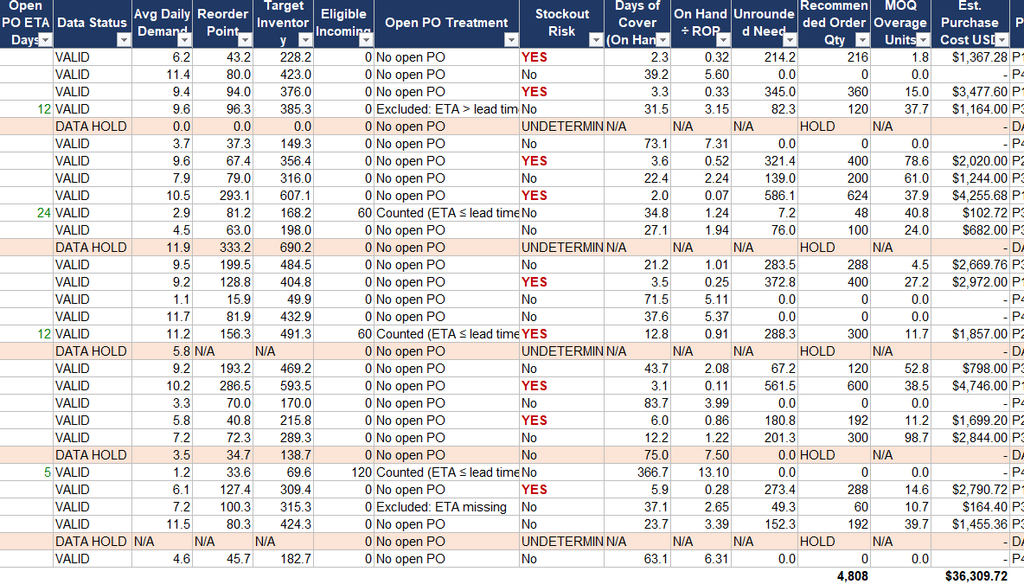
Figure 2. Claude Cowork’s SKU-level inventory analysis from the same 30-SKU test, showing stockout risks, purchase order eligibility, MOQ adjustments, and recommended purchasing quantities.
Both agents identified nine stockout-risk SKUs and recommended purchasing 4,808 units across 18 products.
Both calculated an estimated purchasing cost of $36,309.72.
They also identified five SKUs requiring additional data verification.
| Purchasing Result | Both Agents |
|---|---|
| Total inventory products | 30 |
| Products with usable data | 25 |
| Products at stockout risk | 9 |
| Products recommended for ordering | 18 |
| Total recommended units | 4,808 |
| Estimated purchasing cost | $36,309.72 |
| Products requiring data review | 5 |
These results matched the independent reference calculations for the reported purchasing totals and SKU-level recommended quantities.
This is an encouraging result, but it does not mean AI-generated purchasing reports are automatically error-free.
The task involved a predefined calculation framework. Neither agent had to invent an inventory policy or independently decide the company’s financial risk tolerance.
The practical lesson: AI agents can be effective at applying structured business rules to spreadsheet data, provided the inputs and instructions are clearly defined and the outputs are verified.
4. Finding #1: ChatGPT Work Finished Faster
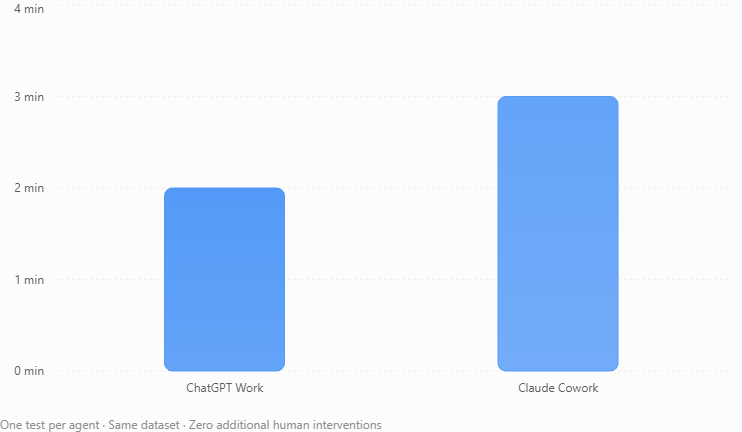
Figure 3. ChatGPT Work completed the 30-SKU inventory analysis in 2 minutes, compared with 3 minutes for Claude Cowork. Both required zero additional human interventions.
The clearest measurable difference was completion time.
ChatGPT Work: 2 minutes
Claude Cowork: 3 minutes
ChatGPT Work finished approximately 33% faster than Claude Cowork in this individual run.
Both completed the work without additional human intervention.
For a small business that performs similar reporting tasks repeatedly, execution speed could influence productivity.
However, one minute of difference in a single test should not determine a purchasing decision by itself.
We did not perform repeated trials, control for server conditions, or measure subscription and usage costs.
The test therefore does not establish that ChatGPT Work is generally faster or more cost-effective.
Finding: ChatGPT Work won the observed speed comparison.
5. Finding #2: Claude Cowork Delivered a More Detailed Workbook Structure
Both agents produced usable Excel workbooks, but they organized their deliverables differently.
ChatGPT Work output
The ChatGPT Work report used a relatively compact workbook structure:
- Purchasing report
- SKU calculations
- Source data
This approach kept the report straightforward and relatively easy to navigate.
For an owner or operations manager who primarily wants a purchasing summary and supporting calculations, a compact workbook may be sufficient.
Claude Cowork output
Claude Cowork produced a workbook with more dedicated sections:
- Executive Summary
- Assumptions
- SKU Calculations
- Purchase Recommendations
- Data Exceptions
- Inventory Data
This structure separated purchasing recommendations, assumptions, and data-quality problems into dedicated worksheets.
For a purchasing team, that organization may make the report easier to review and hand off to another employee.
Claude also documented the limitations of its inventory assumptions, including the absence of safety stock, seasonality, freight, duties, and taxes.
Which report was better?
There is no universal winner based solely on the number of worksheets.
A six-sheet workbook is not necessarily more useful than a three-sheet workbook.
The best format depends on the intended user.
For quick executive review, a compact report may be preferable.
For a purchasing manager who needs detailed exceptions and documented assumptions, a more extensively organized workbook may be valuable.
Our assessment: Claude Cowork had the stronger report organization for documentation and review, while ChatGPT Work delivered a more compact output.
6. Finding #3: Both Agents Recognized Data-Quality Problems
One of the most important parts of the experiment was testing how the agents handled unreliable inventory records.
We intentionally included five SKUs with missing, invalid, or uncertain information.
| SKU | Data Problem | Business Implication |
|---|---|---|
| SV-1005 | Zero sales treated as unknown demand | Demand cannot be assumed to be zero |
| SV-1012 | Negative on-hand inventory | Inventory records require reconciliation |
| SV-1018 | Missing supplier lead time | Reorder point cannot be reliably calculated |
| SV-1024 | Missing MOQ | Purchasing constraints are incomplete |
| SV-1029 | Missing sales data | Demand cannot be estimated reliably |
Both agents recognized these records as requiring review rather than generating unsupported purchasing quantities.
Why negative inventory matters
SV-1012 showed an on-hand quantity of negative eight units.
This does not necessarily mean the business physically has negative inventory.
It could indicate a reconciliation error, delayed transaction posting, incorrect stock adjustments, or another data-quality problem.
An AI system should not silently convert that value into a valid inventory count.
The appropriate next step is human verification.
Why missing demand information matters
SV-1029 lacked the sales information required to calculate average daily demand.
Without that information, a reliable reorder point cannot be calculated under the test’s defined rules.
A confident recommendation based on an invented sales figure would be misleading.
What small businesses should learn
Accurate calculations are only part of the challenge.
An AI agent must also recognize when it lacks enough information to make a reliable recommendation.
For businesses exploring broader automation opportunities, our guide to the best AI automation tools for small businesses explains different approaches to building repeatable workflows.
7. Finding #4: The Agents Identified Urgent Stockout Risks
Both agents identified nine valid SKUs with inventory below their reorder points.
Some of those products had so little stock remaining that standard supplier replenishment would likely arrive too late.
Two examples stood out.
SV-1009 — Overnight Sleeping Mask
This product had approximately two days of inventory remaining against a 28-day supplier lead time.
Under steady demand, waiting for a standard replenishment shipment could result in a stockout.
SV-1020 — Probiotic Face Mist
This product had approximately three days of inventory remaining, also against a 28-day supplier lead time.
A standard purchase order alone would not solve the immediate inventory shortage.
Why these findings matter
The purchasing report can help identify which products need urgent attention.
But the actual business response requires additional decisions.
A purchasing manager may need to consider expedited shipping, supplier alternatives, warehouse transfers, demand changes, or temporary sales restrictions.
The agents did not contact suppliers or execute any of those actions.
This distinction matters: Identifying an operational problem is not the same as resolving it autonomously.
8. What About Open Purchase Orders and MOQs?
The challenge also tested two common sources of inventory-planning errors.
Incoming purchase orders
Not every open purchase order should automatically reduce a new purchasing recommendation.
For example, an incoming shipment with an unknown arrival date cannot be assumed to arrive in time.
Similarly, a shipment scheduled outside the specified lead-time window was excluded under our testing rules.
This required the agents to consider purchase order eligibility rather than simply subtracting all incoming inventory.
Minimum order quantities
Supplier MOQs can force a business to order more inventory than its calculated immediate requirement.
Both agents had to round recommended quantities to the appropriate MOQ multiples.
This is important because an otherwise correct demand calculation can still produce an unusable purchase recommendation if supplier ordering constraints are ignored.
The resulting quantities were planning recommendations, not approved purchase orders.
9. What This Experiment Does Not Prove
The results were encouraging, but there are important limitations.
First, the dataset was synthetic. It represented a realistic small-business inventory scenario but did not use live purchasing transactions.
Second, we tested each agent only once. Multiple trials would be required to evaluate consistency and typical performance.
Third, the calculation rules were predefined. We tested execution of a structured workflow rather than independent inventory-policy design.
Fourth, we did not test external system execution. Neither agent placed orders, emailed suppliers, updated an ERP system, or modified inventory records.
Fifth, we did not compare total operating costs. Subscription fees, usage limits, integration expenses, and employee review time were not measured.
Sixth, the purchasing model was simplified. It excluded safety stock, seasonality, variable supplier performance, freight, duties, and taxes.
Finally, matching calculations in a single test do not guarantee that future reports will be accurate.
Small businesses should continue to validate AI-generated financial and operational recommendations before acting on them.
10. ChatGPT Work vs Claude Cowork: Which Should a Small Business Choose?
Based on this experiment, both platforms demonstrated the ability to complete a structured inventory-analysis assignment.
The better choice depends on the business’s priorities.
Choose ChatGPT Work if you prioritize:
- Fast completion of the tested workflow
- Compact Excel reporting
- Structured calculations using supplied rules
- Producing a finished deliverable with minimal interaction
In our test, ChatGPT Work completed the assignment in two minutes with no additional instructions.
Consider Claude Cowork if you prioritize:
- Detailed reporting structure
- Separate assumptions and exception documentation
- Purchasing recommendations organized for review
- A workbook that can be handed to another employee for further evaluation
In our test, Claude Cowork completed the assignment in three minutes with no additional instructions.
What we would do in a real small business
We would start with a narrow, repeatable workflow and clear validation rules.
For inventory management, that means:
- Maintain accurate source inventory data.
- Define purchasing formulas and approval thresholds.
- Use an AI agent to generate recommendations.
- Review exceptions and unusual quantities.
- Require human approval before placing purchase orders.
- Monitor results and refine the workflow over time.
The objective should be to reduce repetitive administrative work while preserving operational control.
If your company is considering other practical workflows, see our guide to automating invoice processing with AI for another example of AI applied to business operations.
11. Final Verdict: Accuracy Was a Tie, but the Deliverables Differed
In our ChatGPT Work vs Claude Cowork inventory test, both agents successfully completed the core purchasing calculations without additional human intervention.
They identified nine stockout-risk SKUs, recommended 4,808 units, and calculated an estimated purchasing cost of $36,309.72.
First, both AI agents successfully completed the core purchasing calculations.
In our ChatGPT Work vs Claude Cowork inventory test, both agents identified nine stockout-risk SKUs, recommended 4,808 units, and calculated an estimated purchasing cost of $36,309.72.
Second, ChatGPT Work completed the task faster.
It finished in approximately two minutes compared with three minutes for Claude Cowork.
Third, Claude Cowork produced a more extensively organized report.
Its separate assumptions, exceptions, and purchasing recommendation worksheets may be useful for teams that require detailed documentation.
Neither agent needed additional human instructions after the initial prompt.
Our BetterBizLab verdict
Calculation accuracy: Tie
Observed speed: ChatGPT Work
Report organization: Claude Cowork
Overall: Both performed well in this specific inventory-planning challenge.
We would not declare one platform universally superior based on a single run.
For small businesses, the real value of AI agents is not simply generating reports faster.
It’s producing accurate, understandable, and reviewable work that helps employees make better decisions.
That is the standard we’ll continue using in future BetterBizLab experiments.
About this test
This independent BetterBizLab experiment was conducted on October 16, 2026, using synthetic inventory data and identical instructions for ChatGPT Work and Claude Cowork. Each agent was tested once. Completion times were observed manually. The agents’ purchasing calculations were compared with a separately prepared reference workbook. No purchase orders, emails, or external system changes were executed.