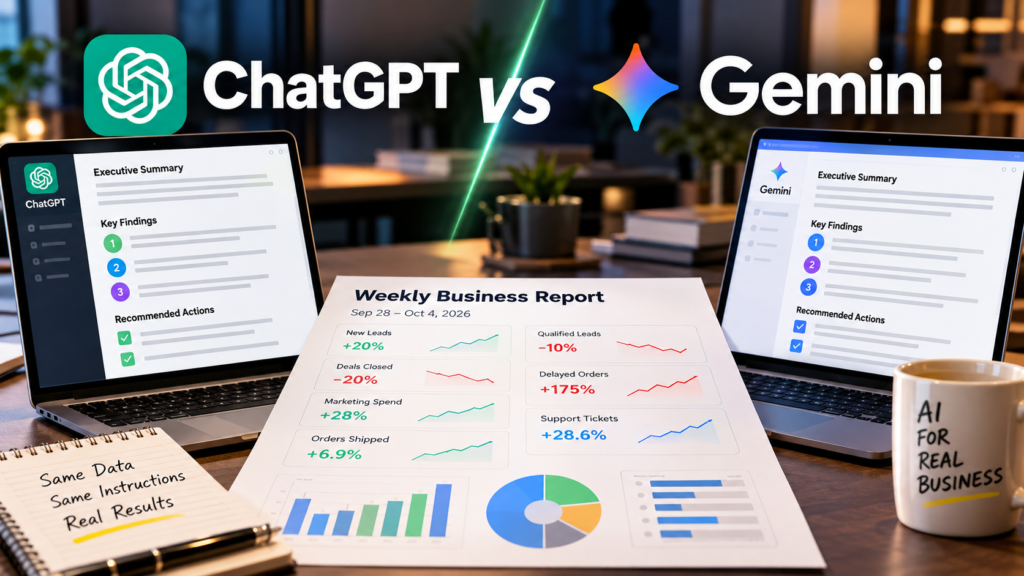
Both AI tools got the numbers right. But one was more careful about what those numbers actually proved.
I tested ChatGPT vs Gemini using the same small-business dataset to see which AI could produce a more accurate, useful, and trustworthy weekly executive report.
Imagine opening your weekly business report and seeing three things at once: new sales leads are increasing, more orders are shipping, and marketing spending is climbing.
At first glance, the business looks busy. Maybe even healthy.
Then you notice that fewer deals are closing, shipping delays have nearly tripled, and your marketing team is spending more to generate fewer qualified leads.
Which problems should you address first?
That’s the question I wanted to test with ChatGPT and Google Gemini.
Rather than asking both tools to write a generic business summary, I gave them the same fictional small-business dataset, the same instructions, and a more demanding assignment: prepare a weekly report that a CEO could actually use.
The results were closer than I expected on the calculations. The more interesting differences appeared in how each AI interpreted the data.
The Test: One Business, Two AI Tools, Same Instructions
OpenAI’s official data analysis guide explains how ChatGPT can work with spreadsheets and turn raw business data into useful insights. Google also provides official Gemini file analysis documentation covering spreadsheet uploads and analysis features.
For this experiment, I created a synthetic dataset representing a small distribution company’s weekly operations.
It contained 12 records covering five business functions: Sales, Marketing, Operations, Customer Support, and Finance.
The reporting period was September 28 through October 4, 2026.
The dataset wasn’t especially large or technically complicated. That was intentional. Many small businesses don’t have sophisticated business intelligence systems. Their weekly reporting might involve a handful of exports from a CRM, accounting software, and operational spreadsheets.
I also included a few complications that a responsible analyst should notice.
The company had 19 open sales quotes, but six had no follow-up logged during the previous seven days. Finance reported $14,750 in overdue invoices, including a $6,200 invoice whose payment status hadn’t been independently verified.
Two fields were deliberately left blank: the lead conversion rate and the root cause of delayed orders.
These missing details mattered. I wanted to see whether the AI tools would acknowledge them or quietly fill in the gaps.
What I asked both tools to do
Each AI received the same CSV and identical instructions.
The assignment required nine things, including calculating week-over-week changes, identifying the three most important business problems, ranking those problems, recommending management actions, separating facts from assumptions, and explaining what still needed human verification.
I evaluated their first responses without asking either model to correct or improve its work.
This was a controlled, single-run comparison using synthetic data—not a comprehensive benchmark of either platform.
First, Did They Get the Math Right?
Yes. Both tools correctly calculated the seven week-over-week changes supported by the dataset.
| Business metric | Previous week | Current week | Change |
|---|---|---|---|
| New sales leads | 35 | 42 | +20.0% |
| Deals closed | 10 | 8 | −20.0% |
| Marketing spend | $2,500 | $3,200 | +28.0% |
| Qualified leads | 20 | 18 | −10.0% |
| Orders shipped | 116 | 124 | +6.9% |
| Delayed orders | 4 | 11 | +175.0% |
| New support tickets | 21 | 27 | +28.6% |
Neither tool made an arithmetic error in these seven comparisons.
That may sound like a basic achievement, but accuracy is the minimum requirement for any AI-generated business report. A polished executive summary is worthless if the underlying calculations are wrong.
Both tools also recognized that the dataset didn’t contain enough historical information to calculate changes for open quotes, unresolved support tickets, or overdue invoices.
So far, this was effectively a tie.
Where ChatGPT Went a Step Further
ChatGPT identified an additional metric that Gemini didn’t include: marketing spending per qualified lead.
The calculation was straightforward.
Previous week: $2,500 ÷ 20 qualified leads = $125 per qualified lead.
Current week: $3,200 ÷ 18 qualified leads = approximately $177.78 per qualified lead.
That’s a 42.2% increase.
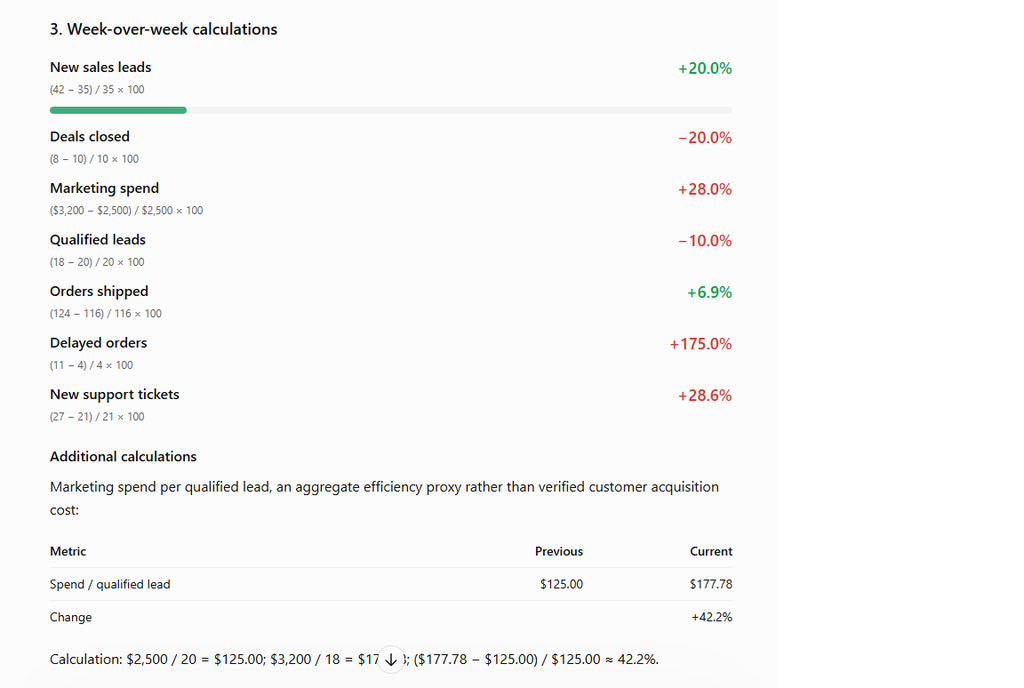
This was one of the most useful findings in the entire experiment.
Marketing spending had increased 28%, while qualified leads had declined 10%. Looking at those two numbers separately tells you something may be wrong. Combining them into a comparable efficiency metric makes the problem easier to investigate.
ChatGPT also included an important qualification: spending divided by qualified leads is an aggregate reporting metric, not necessarily a verified customer acquisition cost.
Without knowing which campaigns produced which leads, or whether the spending and leads belong to the same attribution period, it would be misleading to treat this number as definitive campaign performance.
That combination—an additional useful calculation followed by a clear limitation—is exactly what I want from an AI business analyst.
Gemini Produced a Solid Report, but Some Language Was Too Confident
Gemini’s report was structured and easy to follow.
It summarized each department, showed the week-over-week calculations, identified management problems, and recommended actions.
It correctly highlighted the 175% increase in delayed orders as the highest-priority operational concern.
It also flagged the six open quotes without recent logged follow-ups and the unverified $6,200 invoice.
Where I became more cautious was in some of the language used to interpret the results.
For example, Gemini described the situation as declining conversion efficiency and pipeline stagnation.
Those interpretations might eventually prove correct. But the dataset didn’t establish a valid sales conversion rate.
It showed that new leads increased while closed deals decreased. Those numbers don’t necessarily represent the same customer cohort or sales cycle.
A deal closed this week may have originated from a lead generated months earlier.
Gemini did acknowledge the missing conversion-rate definition elsewhere in its report. The issue wasn’t that it completely ignored the limitation. It was that its executive summary sometimes sounded more certain than the evidence justified.
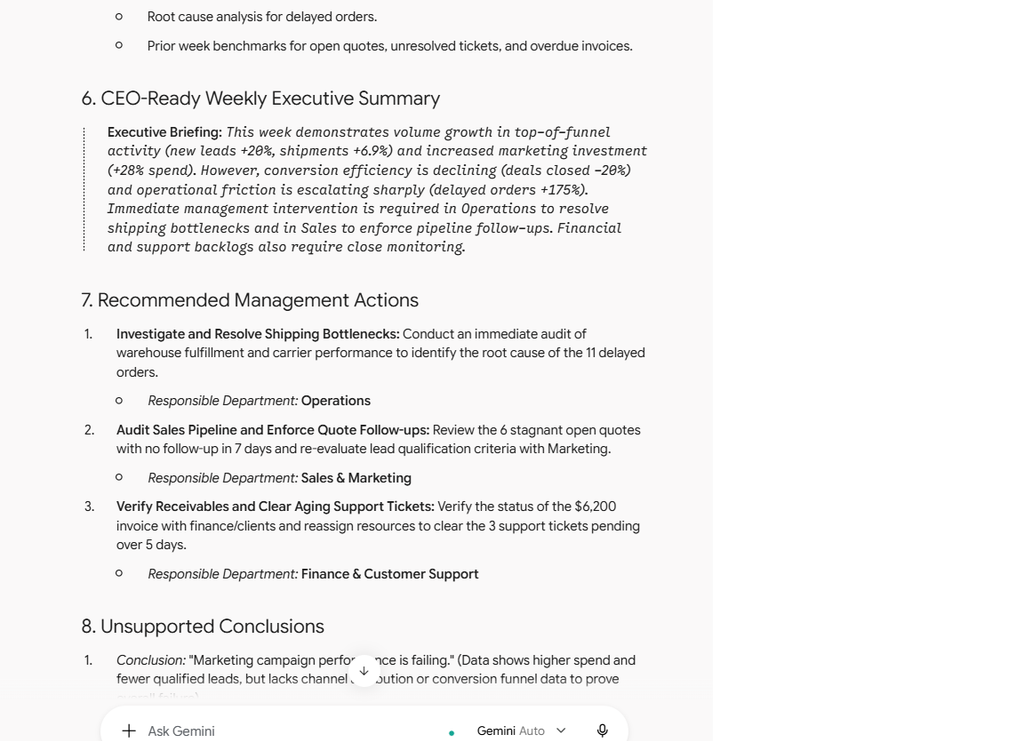
It also referred to shipping bottlenecks even though the dataset didn’t identify why orders were delayed.
These are small wording differences, but they matter when managers use AI-generated reports to make decisions.
A CEO reading “shipping bottleneck” might immediately focus on warehouse staffing or carrier performance. Yet the underlying problem could be something else entirely.
The appropriate next step is to investigate the delayed orders—not assume their cause.
What ChatGPT Handled Better
ChatGPT was more consistent about separating observed facts from possible explanations.
It explicitly warned that fewer closed deals did not establish a decline in revenue.
It also refused to calculate a conversion rate without a valid definition and denominator.
For the increase in delayed orders, it distinguished between the confirmed numerical change and the unknown operational cause.
Another useful difference appeared in how the tools organized management priorities.
ChatGPT separated its three primary concerns into delivery reliability, marketing efficiency, and sales follow-up gaps. It recommended investigating overdue receivables in parallel.
Gemini grouped sales and marketing into one priority and combined finance with customer support in another.
Neither structure is inherently wrong. But for a small-business owner assigning tasks to different departments, I found ChatGPT’s approach slightly easier to act on.
Its recommended actions were also tied to specific records: review all 11 delayed orders, reconcile campaign spending with qualified leads, and investigate the six open quotes without logged follow-ups.
That made the report feel less like a general business commentary and more like a practical management checklist.
ChatGPT vs Gemini: My Test Results
I evaluated both first responses using a 100-point editorial rubric.
| Evaluation category | Maximum | ChatGPT | Gemini |
|---|---|---|---|
| Calculation accuracy | 30 | 30 | 30 |
| Identification of business problems | 25 | 23 | 22 |
| Handling uncertainty and unsupported claims | 20 | 19 | 15 |
| Executive reporting usefulness | 15 | 13 | 12 |
| Actionable recommendations | 10 | 9 | 7 |
| Total | 100 | 94 | 86 |
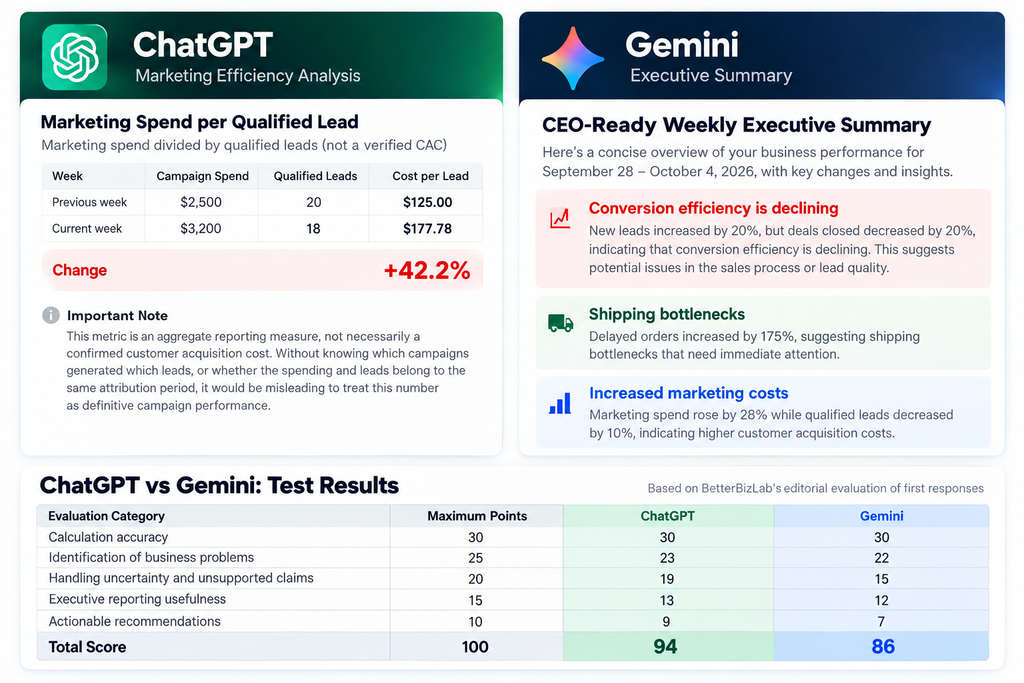
These scores reflect my assessment of the two outputs in this specific experiment. They are not standardized model benchmarks, and an eight-point difference in one test doesn’t establish that ChatGPT will outperform Gemini across other business reporting tasks.
Both tools performed well on the calculations.
ChatGPT earned the higher score primarily because it produced an additional useful efficiency metric, communicated uncertainty more consistently, and made the next management steps easier to separate.
Gemini remained a capable reporting assistant, particularly for organizing the information into a readable departmental summary.
The Biggest Risk Wasn’t a Wrong Number
The most interesting lesson from this experiment wasn’t about arithmetic.
Both AI tools handled the arithmetic correctly.
The bigger risk was that an AI-generated report could turn a reasonable hypothesis into something that sounds like an established business fact.
Consider these three statements:
“Deals closed declined by 20%.”
“The sales conversion rate declined.”
“The sales team is failing to convert leads.”
They sound related, but they are not interchangeable.
The first statement is supported by the supplied data.
The second requires a defined conversion calculation and compatible cohorts.
The third requires substantially more evidence about lead quality, sales processes, timing, and individual performance.
An AI report becomes dangerous when it moves from the first statement to the third without acknowledging what’s missing.
That’s why I would rather receive a slightly less polished report that clearly identifies uncertainty than a confident executive summary built on unsupported assumptions.
How I Would Actually Use AI for Weekly Business Reporting
If you’re planning to move beyond manual weekly uploads, our guide to the best AI automation tools for small business explains the broader workflow options worth considering.
After this test, I wouldn’t ask AI to make management decisions automatically.
I would use it to prepare a first-pass exception report.
Each week, I would export relevant data from the company’s existing systems and ask AI to identify changes, check calculations, flag missing information, and propose investigation priorities.
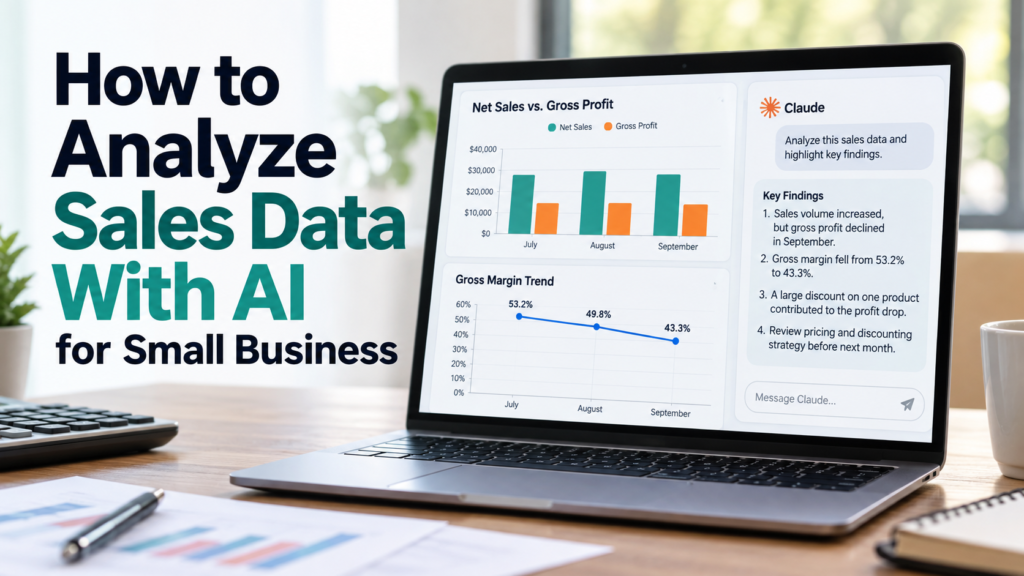
If you want to see how this works with actual sales figures, our AI sales data analysis test walks through a separate experiment involving sales volume, discounts, and profit margins.
Then I would have the responsible managers verify the findings.
Operations would confirm the delayed orders and their actual causes.
Sales would review the open quotes and customer contact history.
Marketing would reconcile spending, attribution, and qualified-lead definitions.
Finance would verify outstanding invoices against the accounting records.
The final report would separate verified findings from unresolved questions.
This approach preserves the speed advantage of AI without handing it authority over decisions that require business context.
A prompt worth trying
If you want to test a similar workflow, start with this:
“Analyze this weekly business dataset for a small-business CEO. Calculate every supported week-over-week change and show your math. Identify the three most important issues requiring attention. Separate confirmed facts from possible explanations. Do not infer missing conversion rates, root causes, or financial outcomes. Recommend specific next steps, identify which departments should investigate them, and clearly state what must be verified before management acts.”
You can make the prompt more useful by adding your own company’s definitions for qualified leads, delayed orders, gross margin, and other important metrics.
Those definitions matter as much as the AI model you choose.
What This Test Doesn’t Prove
There are several limitations worth keeping in mind.
I used one small, synthetic dataset and one prompt. I did not repeat the test across multiple datasets, reporting periods, or model configurations.
I also didn’t test whether either platform could connect directly to a company’s live systems, refresh reports automatically, or maintain consistent accuracy over time.
The dataset contained no underlying invoice records, individual order histories, or detailed customer transactions. That limited what either model could verify independently.
And because both tools received the same deliberately structured data, the test doesn’t establish how well they would handle inconsistent real-world exports or poorly formatted documents.
These are important boundaries. The experiment evaluates the quality of two generated reports, not the reliability of a complete automated reporting system.
Final Verdict: Which Would I Use?
For this particular weekly reporting task, I preferred ChatGPT.
Not because it was dramatically better at calculations. It wasn’t.
The right AI tool also depends on the task. In our ChatGPT vs Claude for small business comparison, we explored how the tools differ across everyday business workflows.
Both tools got the core math right.
ChatGPT’s advantage was in how it interpreted the numbers, added a useful marketing efficiency calculation, and communicated the limits of the available evidence.
Gemini was capable of producing a readable, organized executive report. But some of its conclusions needed more cautious wording before I would share them with a management team.
My practical takeaway is simple:
Use AI to accelerate business reporting, but make it show its calculations, distinguish facts from assumptions, and identify what it doesn’t know.
A good weekly report shouldn’t just tell a CEO what changed.
It should help the CEO understand what deserves attention—and what still needs to be checked before making a decision.
BetterBizLab tested both tools using the same synthetic business dataset and identical instructions. The observations above are based on their first responses and should not be interpreted as a general ranking of the platforms.