By Jacob | November 24, 2026
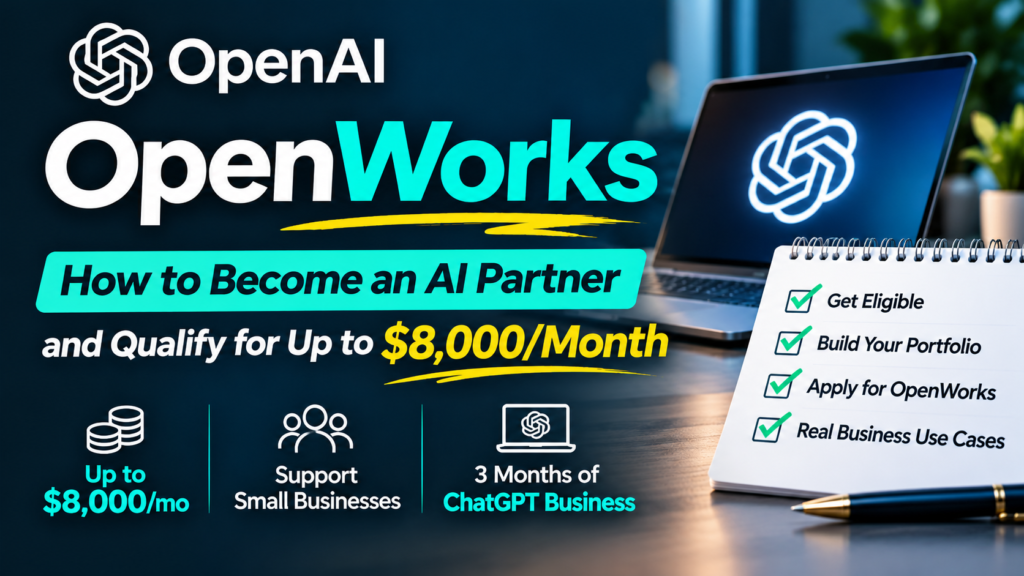
When I first came across OpenAI’s new OpenWorks program, the $8,000 monthly stipend caught my attention. But as someone who runs a business and regularly explores how AI can improve everyday operations, I was more interested in what OpenAI is actually trying to accomplish.
There is a significant gap between knowing how to use AI and knowing how to implement it inside a real business.
Most small business owners don’t need another presentation explaining how powerful artificial intelligence is. They need someone who can sit down with their team, understand their problems, and help them find a better way to work.
That is where I see the real potential of OpenAI OpenWorks.
For experienced AI users, freelancers, and aspiring AI consultants, this could be an interesting professional opportunity. However, before getting excited about the financial incentive, it is worth understanding what the program requires and whether you can realistically deliver value to local businesses.
I’ve reviewed the official program information and approached this opportunity from both a business owner’s perspective and the perspective of someone interested in building an AI consulting practice.
Here is what you should know.
Table of Contents
What Is OpenAI OpenWorks?
OpenAI OpenWorks is a U.S. initiative that connects local AI practitioners with small businesses that need practical assistance adopting artificial intelligence.
The idea addresses a problem that technology alone cannot solve: businesses need help turning AI capabilities into useful operational improvements.
OpenAI supports the practitioners, while participating businesses receive assistance without paying for the program. Eligible businesses also receive three complimentary months of ChatGPT Business.
For a neighborhood retailer, that assistance might involve improving inventory management. For a distributor, it could mean simplifying paperwork. For a small marketing agency, it might involve reducing the time spent preparing customer reports.
What interests me most is that the business owner gets to identify the problem. The technology should follow the business need, not the other way around.
How Much Can OpenAI OpenWorks Partners Earn?
The program advertises a stipend of up to $8,000 per month.
That sounds attractive, particularly for someone who is already working independently or running a small consulting practice. However, the words “up to” are important.
Here is how I would summarize the opportunity based on the currently available program information.
| Program Detail | Current Information |
|---|---|
| Maximum monthly stipend | $8,000 |
| Working arrangement | Contractor |
| Business support commitment | At least four full days monthly |
| Educational commitment | Monthly community workshop |
| Guaranteed payment amount | Not disclosed |
| Funding duration | Not disclosed |
| Payment calculation | Not disclosed |
I would not build a financial plan around receiving the maximum stipend.
In business, I always want to understand the difference between potential revenue and actual profitability. The same principle applies here.
A consultant may need to spend additional time preparing workshops, traveling, understanding unfamiliar software, documenting workflows, and communicating with business owners.
Those activities have a cost, even when they are not immediately visible.
Before accepting an arrangement, I would want to understand the actual compensation, expected workload, expense reimbursement, deliverables, and contractual responsibilities.
Until those details are clear, consider the advertised amount a potential financial benefit rather than predictable monthly income.
Who Should Consider Becoming an OpenWorks Partner?
I don’t think the most successful AI consultants will necessarily be the people who know the largest number of AI tools.
They will be the people who understand how businesses operate.
A technically impressive automation can still be a terrible business solution if it costs too much, creates additional maintenance, or requires employees to completely change their existing processes.
This opportunity could be particularly interesting for:
- AI freelancers who already build practical workflows.
- Software developers with strong communication skills.
- Business operations professionals who use AI regularly.
- Small consulting firms looking to expand their services.
- Automation specialists who work with nontechnical customers.
- Experienced business owners who understand operational challenges.
An existing consulting company is not essential. OpenAI accepts applications from individuals as well as small teams, and applicants without a registered company can still apply.
A formal degree is not listed among the published application requirements.
What I would concentrate on instead is demonstrating that you can solve a business problem and explain your solution to someone who has never used an AI tool before.
Where Is OpenAI OpenWorks Available?
OpenWorks is initially operating across 20 U.S. communities.
These include Los Angeles, New York, Chicago, Seattle, Austin, Houston, Atlanta, Nashville, Cleveland, Charlotte, and several other cities.
If your location is not currently covered, you can still submit your interest. However, that does not guarantee that the program will become available in your area.
This is a locally focused opportunity. I would not approach it as a fully remote consulting job or an international freelancing platform.
Check the current coverage map on the official OpenWorks website before making any business or relocation decisions.
The AI Skills That Actually Matter
Over the past several months, I’ve explored different ways of using AI for business tasks, including invoice reconciliation, inventory analysis, sales reporting, customer communication, and workflow automation.
One thing that becomes increasingly clear is that getting an AI tool to produce an answer is usually the easy part.
Getting that answer to become a reliable business process is much harder.
If I were evaluating an AI consultant for my own company, these are the five capabilities I would look for.
1. Understanding Business Operations
Before introducing AI, you need to understand how the existing process works.
Who performs the task? Where does the information come from? Who approves the result? What happens when something goes wrong?
If you cannot answer those questions, automating the process may create more problems than it solves.
For example, automating invoice approval without understanding purchase orders, receiving records, and accounting controls would introduce unnecessary financial risk.
2. Choosing the Right AI Tools
Not every problem requires an AI agent.
Sometimes a well-designed spreadsheet, a reusable prompt, or a simple automation is enough.
Small businesses typically have limited budgets and limited technical support. Adding five different software subscriptions to solve one administrative problem may not make financial sense.
The ability to recommend a simple, affordable solution is often more valuable than the ability to build something complicated.
3. Working With Real Business Data
Business data is rarely as clean as a software demonstration makes it appear.
Product descriptions may be inconsistent. Inventory records may contain errors. Customer names may appear in different formats. Different departments may maintain separate spreadsheets containing conflicting information.
An AI consultant needs to recognize these limitations.
You should also understand when sensitive information requires restricted access, anonymization, or explicit permission before being processed.
AI should not become an excuse to bypass existing privacy and security requirements.
4. Teaching Employees
This is probably one of the most underestimated skills in AI consulting.
A workflow is not particularly valuable if the consultant is the only person who knows how to operate it.
When I think about implementing AI in a company with 5–20 employees, I want the existing team to become more capable. I don’t want the business to become permanently dependent on an outside consultant for routine tasks.
A good implementation should include understandable instructions, practical training, and clear responsibilities.
5. Measuring Business Results
I would much rather see a modest AI project with measurable benefits than an impressive demonstration with no clear business outcome.
Useful performance indicators might include time saved, reduced error rates, faster customer response times, lower operating costs, or improvements in sales follow-up.
If you cannot explain how the business benefits, it is difficult to justify expanding the project.
Five Practical AI Consulting Projects for Small Businesses
If you are interested in becoming an OpenWorks partner but are unsure what services you could provide, start with problems that already exist in most businesses.
The following are project ideas, not claims about projects I have delivered through OpenWorks.
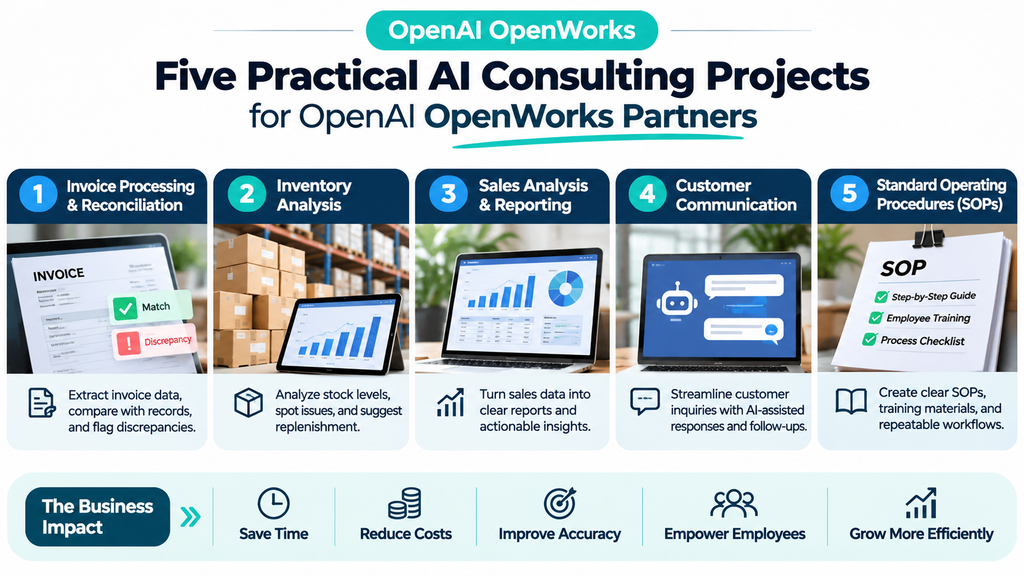
Project 1: Invoice Processing and Reconciliation
Many businesses still spend considerable time manually comparing invoices against purchase orders and other supporting documents.
AI can help extract information, compare records, identify potential discrepancies, and prepare exceptions for human review.
At BetterBizLab, I previously tested ChatGPT and Claude on invoice reconciliation. Both identified a $135 discrepancy in one of our tests.
That does not mean either tool should be trusted to approve payments automatically. It demonstrates how AI can support a financial review process when appropriate controls are in place.
For a consulting project, I would start with a limited batch of invoices and compare the AI-assisted results against the existing manual process.
What to measure: Processing time, extraction accuracy, missed discrepancies, false alerts, and reviewer workload.
Project 2: Inventory Analysis
Inventory is particularly important for retailers, wholesalers, and distributors.
Excess inventory ties up working capital. Insufficient inventory potentially results in lost sales. Both can hurt profitability.
A practical AI project could help a business organize inventory records, identify slow-moving products, flag unusual stock movements, and prepare purchasing recommendations.
I’ve also explored this area through a side-by-side ChatGPT Work and Claude Cowork inventory challenge involving 30 SKUs.
For a typical small business, I would begin with an existing inventory export rather than recommending a complicated new system.
The objective is better inventory decisions, not simply a more attractive dashboard.
What to measure: Reporting time, stock discrepancies, inventory turnover, and usefulness of replenishment recommendations.
Project 3: Sales Analysis and Business Reporting
A business can have thousands of rows of sales information and still struggle to answer basic questions.
Which products are becoming less profitable? Which customers are spending less? Which sales channels are producing revenue without adequate margins?
AI can help organize that information and identify areas that deserve further investigation.
At BetterBizLab, I’ve tested AI tools for sales analysis and business reporting, including comparisons using the same underlying data.
For consulting purposes, I would build a repeatable reporting workflow that a manager could use every week or month.
The final calculations should still be checked against the original financial data.
What to measure: Report preparation time, calculation accuracy, consistency, and usefulness in management decisions.
Project 4: Customer Communication
Small business employees often spend a significant portion of their day answering similar questions, following up with customers, and preparing routine emails.
Before implementing an AI chatbot, I would examine whether a simpler AI-assisted email workflow could solve the problem.
A consultant could help a business develop approved response templates, organize common inquiries, prepare personalized follow-ups, and establish rules for escalating sensitive issues to employees.
The objective is not to remove human interaction. It is to give employees more time for conversations that genuinely require their attention.
What to measure: Average response time, follow-up completion, customer satisfaction, and the percentage of responses requiring corrections.
Project 5: Standard Operating Procedures and Employee Training
Many small businesses rely heavily on knowledge held by individual employees.
When those employees leave or take time off, tasks become difficult to manage because the procedures were never properly documented.
AI can help turn existing instructions, interviews, and approved recordings into structured standard operating procedures.
A well-designed project could include employee onboarding materials, process checklists, and reusable training documents.
However, department managers should review and approve every procedure before employees are expected to follow it.
What to measure: Training time, process consistency, recurring errors, and employee independence.
How to Build a Portfolio for OpenAI OpenWorks
If you are serious about becoming an AI consultant, I wouldn’t recommend spending weeks collecting AI certifications without building anything.
Certifications can be useful, but a real example of solving a problem is more convincing to me as a business owner.
Start by selecting one repetitive task from your own work or a business you have permission to assist.
Document how the task is currently performed. Then design an AI-assisted version, test it, and compare the results.
Your portfolio should explain:
- The original business problem.
- The limitations of the existing process.
- The AI tools and workflow you selected.
- How you tested and verified the results.
- The measurable benefit or remaining limitations.
- How someone else could operate the workflow.
You don’t need a collection of ten elaborate projects.
One well-documented example that demonstrates your decision-making process can be more valuable than several generic AI demonstrations.
If you are using fictional data for a portfolio demonstration, disclose that clearly. Never present simulated results as achievements from a real client engagement.
You also don’t need to reveal confidential customer information to demonstrate your skills. Anonymized examples, authorized screenshots, and carefully documented workflows can communicate your capabilities without exposing sensitive records.
How to Apply for OpenAI OpenWorks
Visit the official OpenWorks website and select the partner application rather than the form for businesses seeking assistance.
Prepare a relevant example of your previous AI work, information about your location and availability, and a link that demonstrates your professional experience.
When explaining your work, focus on the outcome rather than simply listing the tools you know.
For example, here is a hypothetical application description:
I developed and tested an AI-assisted invoice review workflow that compares invoice information against purchasing records and flags potential discrepancies for human review. The project focused on reducing repetitive administrative work while maintaining existing financial approval controls.
That description is more meaningful than saying you are proficient in ChatGPT, Claude, Gemini, and several automation platforms.
It explains what the technology does, why it matters, and how business risk is managed.
Review your application carefully before submitting it. At the time of writing, there is no published process for editing a submitted application.
Keep your own copy of the information you submit. An on-screen confirmation indicates submission, but it does not mean you have been accepted.
Is OpenAI OpenWorks Worth It Financially?
This is where I would approach the opportunity as a business decision rather than simply an AI enthusiast.
The advertised maximum stipend is interesting, but your actual return depends on what you receive and how much time you invest.
Consider the following hypothetical scenarios.
| Monthly Compensation | Total Monthly Hours | Additional Expenses | Effective Hourly Return |
|---|---|---|---|
| $2,000 | 60 | $300 | $28.33 |
| $4,000 | 60 | $300 | $61.67 |
| $8,000 | 60 | $300 | $128.33 |
| $8,000 | 100 | $500 | $75.00 |
These figures are illustrative calculations, not actual OpenWorks payment tiers or workload estimates. Income taxes and other business overhead are excluded.
The formula is simple:
Effective hourly return = (Monthly compensation − Expenses) ÷ Total hours invested
What matters is how the arrangement compares with your other professional opportunities.
For someone who is already building an AI consulting business, the program might offer valuable practical experience and exposure to different business challenges.
For an established consultant with a full schedule of paying customers, the opportunity cost might be considerably higher.
I would also review the contract before making assumptions about future client relationships, additional paid services, intellectual property ownership, or the reuse of project materials.
None of those should be treated as guaranteed business benefits.
What I Think OpenWorks Means for the AI Consulting Industry
For years, small businesses have been told that AI will transform their operations.
But many owners don’t know where to begin, and they don’t have the resources to hire a dedicated technology department.
This is especially relevant for companies with 5–20 employees.
They are large enough to have inefficient processes, recurring administrative work, and communication problems, but often too small to employ specialized automation engineers.
I believe there is a genuine opportunity for people who can bridge that gap.
However, OpenAI also has a commercial reason to encourage wider adoption of its products. That is understandable, but it is something an independent consultant should recognize.
Business owners should evaluate whether the technology is appropriate for their needs, including what it will cost after introductory benefits end.
If OpenWorks grows successfully, it could help more business owners recognize the value of practical AI implementation. It could also increase competition among AI consultants and raise expectations for what those consultants should deliver.
Either way, simply knowing how to write prompts is unlikely to remain a strong competitive advantage by itself.
Understanding businesses, implementing dependable systems, and teaching people how to use them will matter much more.
My Verdict: Is OpenAI OpenWorks Worth Applying For?
If you already use AI to solve practical business problems, I think OpenAI OpenWorks is worth exploring.
You don’t necessarily need to be a software engineer or own an established consulting firm. But you should be comfortable working with real businesses, explaining technology to nontechnical employees, and taking responsibility for the quality of your recommendations.
If your main motivation is earning $8,000 a month with minimal effort, this probably isn’t the right opportunity.
If you enjoy improving business operations and helping people become more productive, the program could be considerably more interesting.
Personally, what attracts me to this opportunity is not just the financial incentive. It is the possibility of working with different businesses, learning how their operations function, and finding practical ways AI can make those businesses better.
That is also what I believe good AI consulting should be about.
Start by solving one real problem. Document your work, verify the outcome, and make sure the people using your solution can continue using it without you.
Whether or not you are accepted into OpenWorks, those skills will still be valuable.
Frequently Asked Questions
Is OpenAI OpenWorks a job?
It is a contractor-based program rather than a conventional salaried position at OpenAI.
Is the $8,000 monthly stipend guaranteed?
No. The advertised figure is the maximum potential stipend. Individual compensation and its duration have not been publicly specified.
Can beginners apply?
Practical AI experience is important. If you are completely new to AI implementation, I would recommend developing a small portfolio before applying.
Do I need an LLC to apply?
No. Individuals without an established company can apply.
Can I participate from outside the United States?
The current pilot focuses on locally delivered assistance within the United States. Do not assume international or fully remote participation is available.
Is there an application deadline?
No general deadline is currently published. Check the official program information for future changes.
Should I quit my existing job to pursue OpenWorks?
I would not recommend leaving stable employment solely because of the advertised maximum stipend. Understand your actual contract and financial commitment before making that decision.
Can OpenWorks help me start an AI consulting business?
Potentially, it could help you develop relevant experience. However, acceptance, income, future customers, and permission to offer additional commercial services are not guaranteed.
About BetterBizLab
BetterBizLab explores practical ways small businesses can use AI to improve productivity, reduce operational costs, and make better business decisions. Our approach focuses on real workflows, hands-on testing, and the business value behind emerging technology.
Editorial note: This article is an independent analysis of OpenAI OpenWorks. BetterBizLab has not verified the program through direct participation. Program information was reviewed on November 24, 2026, and may change. Readers should confirm current requirements and contractual terms before applying.