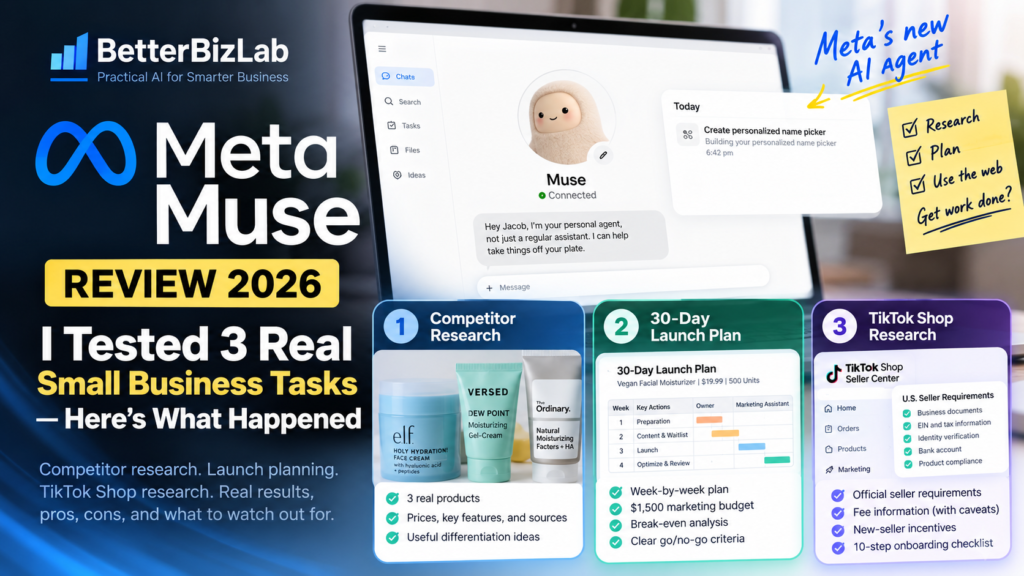
This Meta Muse review is based on three hands-on small business tests: competitor research, a 30-day product launch plan, and TikTok Shop seller research. We evaluated what Muse delivered, checked its calculations and selected sources, and identified the mistakes business owners should know about before relying on an AI agent.
Updated: October 20, 2026
Quick verdict: Meta Muse produced useful work across all three of our small-business tests, earning 63 out of 75 points on BetterBizLab’s editorial scorecard. Its strongest qualities were organizing complicated research, creating structured business plans, and acknowledging missing information. Its biggest weakness was more subtle: plausible recommendations sometimes overlooked important details that could change a business decision.
We would use Muse to accelerate research and planning. We would not use its output as the final authority for pricing, compliance, financial decisions, or sensitive business operations.
What Is Meta Muse?
Meta Muse is a personal AI agent introduced by Meta on September 8, 2026.
Unlike a conventional chatbot that primarily responds to prompts, Muse is designed to work through tasks, use a dedicated browser environment, and interact with connected applications when authorized.
Meta describes its underlying environment as Muse Secure VM, a dedicated virtual machine designed to separate agent activity and data from other environments.
That is an ambitious proposition. A business owner could potentially ask an agent to research competitors, organize information, prepare a project, or work through tasks involving several applications.
But an AI agent’s advertised capabilities and its observed performance are two different things.
For this review, we focused on what we could actually test.
What about Muse Wonder?
On October 12, Meta announced Muse Wonder and Muse Wonder Full, newer models intended for more advanced agentic work.
According to Meta’s announcement, Muse Wonder was initially available through developer products, with broader Muse availability planned afterward, beginning with subscribers.
We did not establish that Muse Wonder powered our test account. Our results should not be interpreted as a benchmark of that newer model.
Sources: Meta’s Muse introduction and Muse Wonder announcement.
If you’re evaluating Muse alongside other options, our guide to the best AI tools for small business in 2026 explains how we assess AI software based on practical business value, cost, and the need for human oversight.
How We Conducted This Meta Muse Review
We accessed Muse through its web interface and ran three practical scenarios based on tasks a small U.S. business might encounter.
We deliberately avoided a generic question-and-answer benchmark.
Instead, we wanted to know whether Muse could produce something a business owner might actually use.
Our three tests were:
- Competitor research: Find and assess three vegan facial moisturizers sold in the U.S. for under $25.
- Business planning: Create a 30-day launch plan for a skincare product, including responsibilities, marketing budget, and break-even analysis.
- Web research: Investigate U.S. TikTok Shop seller requirements, fees, and onboarding using official resources.
The first two scenarios used fictional business circumstances. The third involved real public seller-policy information.
We did not connect business accounts, grant access to customer data, make purchases, send emails, or authorize external transactions.
Our scoring method
We assigned each test five criteria worth up to five points each, for a maximum of 25 points per test.
These were practical editorial assessments, not standardized scientific measurements.
| Test | Score |
|---|---|
| Competitor research | 20/25 |
| Business launch planning | 21/25 |
| TikTok Shop web research | 22/25 |
| Total | 63/75 (84%) |
The score reflects the usefulness and limitations of these particular outputs. It does not establish that Muse is 84% accurate in general, nor does it compare Muse directly with ChatGPT, Claude, or Gemini.
Test 1: Can Muse Research Competitors for a Small Skincare Brand?
Score: 20/25
Our first assignment was straightforward: research three vegan facial moisturizers available in the United States for less than $25.
We asked for product names, prices, sizes, selling points, source URLs, competitive weaknesses, and three differentiation strategies for a new skincare brand.
We also instructed Muse not to invent information it could not verify.
What Muse delivered
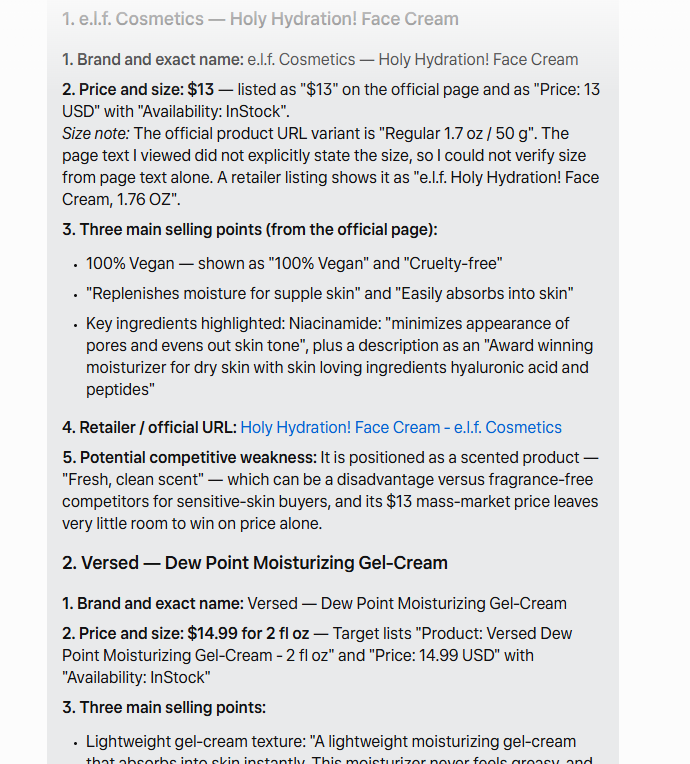
Muse selected:
| Product | Price reported by Muse | Size reported |
|---|---|---|
| e.l.f. Holy Hydration! Face Cream | $13 | Approximately 1.7 oz |
| Versed Dew Point Moisturizing Gel-Cream | $14.99 | 2 fl oz |
| The Ordinary Natural Moisturizing Factors + HA | $8 | Not conclusively verified |
These are real products, and Muse provided product-page links rather than presenting unsupported product names.
It also identified positioning differences.
For example, Muse described e.l.f. as an affordable moisturizer with recognizable ingredients, Versed as a lightweight gel-cream, and The Ordinary as a low-price option focused on straightforward hydration.
That gave us a useful initial view of the category.
What worked
The most encouraging behavior was Muse’s handling of uncertain product sizes.
For The Ordinary, it did not confidently assign a particular bottle size to the reported $8 price because it could not establish the relationship from the source it accessed.
That matters.
An AI assistant that invents a size can make a price-per-ounce comparison look authoritative while quietly making it wrong.
Muse also went beyond summarizing product pages. It recommended that a new brand differentiate through a narrower customer need, stronger transparency, and better service.
Those ideas were relevant to the assignment.
What Muse missed
One of Muse’s suggested weaknesses for e.l.f. was that the product was scented, potentially leaving room for a fragrance-free competitor.
That observation was not necessarily wrong for the specific variant it discussed.
However, e.l.f. also sells a fragrance-free version of Holy Hydration! Face Cream.
This changes the strategic interpretation.
A small skincare brand considering a fragrance-free launch should not conclude that e.l.f. has left that segment uncontested.
The broader lesson is important: accurate information about one product variant can still lead to an incomplete competitive analysis.
We also found that Muse treated some individual customer-review complaints as potential competitive weaknesses. Reviews can generate useful hypotheses, but a few complaints do not establish a widespread product defect.
And while Muse suggested options such as dermatologist-reviewed testing and refillable packaging, it did not estimate the cost or operational burden of implementing them.
BetterBizLab’s assessment
Muse was effective at building a first-pass competitive research document.
We would use its output to identify products, positioning claims, and questions worth investigating.
We would still verify product variants, prices, review patterns, and differentiation costs before making a launch decision.
Test 1 verdict: A strong research starting point, but not a substitute for category-level judgment.
Test 2: Can Muse Build a Realistic 30-Day Business Launch Plan?
Score: 21/25
The second test was more demanding.
We gave Muse a fictional skincare launch with the following constraints:
- Retail price: $19.99
- Product cost: $5.50 per unit
- Initial inventory: 500 units
- Marketing budget: $1,500
- Launch timeline: 30 days
- Channels: Shopify and TikTok Shop
- Team: one owner and one part-time marketing assistant
We asked for a weekly action plan, responsibility assignments, budget allocation, measurable KPIs, break-even analysis, launch risks, and go/no-go criteria.
We specifically told Muse not to invent shipping fees, platform fees, or conversion rates.
What Muse delivered
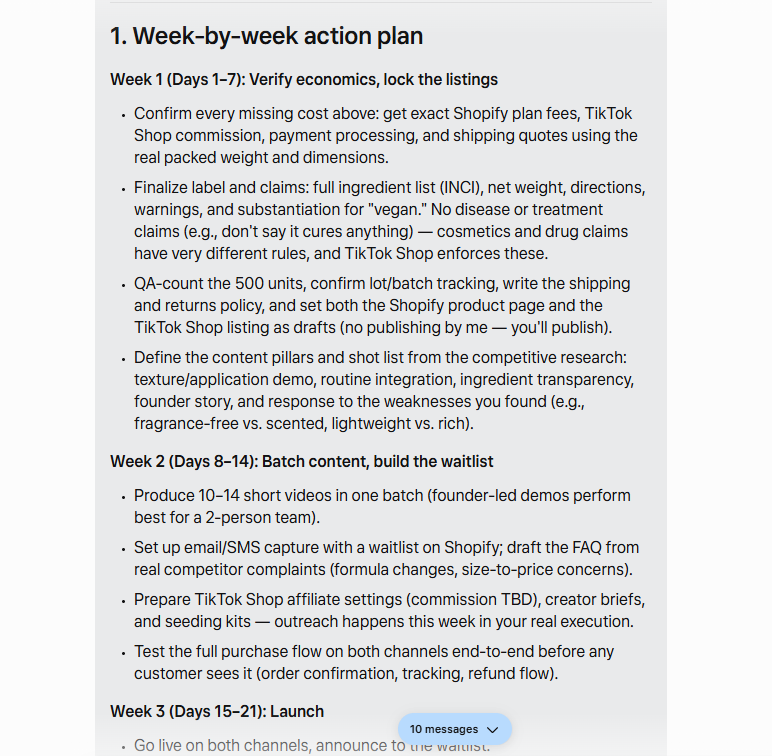
Muse organized the launch into four stages.
Week 1: Confirm product economics, review claims and labeling, prepare listings, and establish fulfillment procedures.
Week 2: Produce marketing content, prepare an email waitlist, and organize affiliate and creator materials.
Week 3: Launch the product, publish content, test advertising, and monitor early orders.
Week 4: Evaluate performance, reconcile costs, improve weak campaigns, and make a reorder decision.
The sequence was coherent and reasonably practical.
The marketing budget
Muse allocated the $1,500 as follows:
| Expense | Budget |
|---|---|
| TikTok advertising | $600 |
| Paid creator content | $400 |
| Sample shipping and packaging | $250 |
| Content-production supplies | $100 |
| Email/SMS tools | $50 |
| Optimization reserve | $100 |
| Total | $1,500 |
The arithmetic was correct.
It also correctly distinguished product gross margin from actual contribution profit.
The financial calculation
At a $19.99 selling price and $5.50 product cost:
Gross profit per unit = $14.49
Product gross margin = approximately 72.49%
For 500 units, the theoretical totals before additional expenses are:
| Metric | Amount |
|---|---|
| Sales revenue | $9,995 |
| Product cost | $2,750 |
| Product gross profit | $7,245 |
Muse correctly warned that the $7,245 figure was not the business’s actual profit.
Shipping, fulfillment, platform fees, refunds, and marketing expenses still matter.
It then constructed break-even scenarios using different assumptions for additional variable costs.
| Other variable cost per unit | Contribution before marketing | Units needed to recover $1,500 |
|---|---|---|
| $0 | $14.49 | 104 |
| $3 | $11.49 | 131 |
| $5 | $9.49 | 159 |
| $8 | $6.49 | 232 |
The scenario arithmetic checked out.
But these figures were illustrations, not actual forecasts. The real business would need verified costs before using them to approve spending.
The important mistakes
The first problem involved customer acquisition cost.
Muse wrote that selling 150 units against a $1,500 marketing budget would imply a $10 CAC.
That is only true if those 150 units represent 150 newly acquired customers.
If 100 new customers purchased 150 units, the CAC would instead be $15 per new customer.
Units sold and new customers acquired are not interchangeable.
That distinction becomes important when evaluating paid acquisition.
The second problem was sample economics.
Muse budgeted for sample postage and packaging but treated the sample products themselves as inventory outside the $1,500 marketing allocation.
For example, sending 20 sample units would consume another $110 of product cost.
That cost must appear somewhere in the full launch-profit calculation, even if management chooses to track it outside the cash marketing budget.
The third problem was execution capacity.
Muse recommended producing 10–14 short videos, publishing daily, running live sessions, managing affiliates, and overseeing fulfillment.
For a team consisting of one owner and one part-time assistant, that could be overly ambitious.
Interestingly, Muse itself recognized team capacity as a major risk. Yet it did not substantially reduce the proposed workload.
What about the go/no-go rules?
Muse proposed useful thresholds around contribution profit, returns, fulfillment, and customer acquisition.
But its rules left an ambiguous gap: a return rate below 10% qualified under one GO condition, while 15% or higher triggered NO-GO.
What should happen between 10% and 15%?
That range needed an explicit review rule.
The broader lesson is that a well-formatted decision framework can still contain incomplete logic.
BetterBizLab’s assessment
This was arguably Muse’s most commercially useful output.
The plan could save a business owner meaningful preparation time. Its cost discipline was better than a generic launch checklist, and it resisted the temptation to invent missing platform fees.
However, we would not approve a $1,500 campaign based solely on this document.
The CAC definition, sample costs, staffing assumptions, and decision thresholds need human review.
Test 2 verdict: Excellent for a structured planning draft; not ready for unreviewed budget approval.
Test 3: Can Muse Research TikTok Shop Seller Requirements?
Score: 22/25
Our third assignment focused on current public information rather than a hypothetical launch.
We asked Muse to investigate the requirements for a U.S. skincare business opening a TikTok Shop.
The assignment included five deliverables:
- Find the official U.S. registration page.
- Identify business registration documents.
- Find official seller fee information.
- Identify new-seller incentives and their eligibility.
- Produce a practical ten-step onboarding checklist.
We required direct source URLs and a clear separation between verified information, unknowns, and recommendations.
We also prohibited logging in, submitting forms, or creating accounts.
What Muse delivered
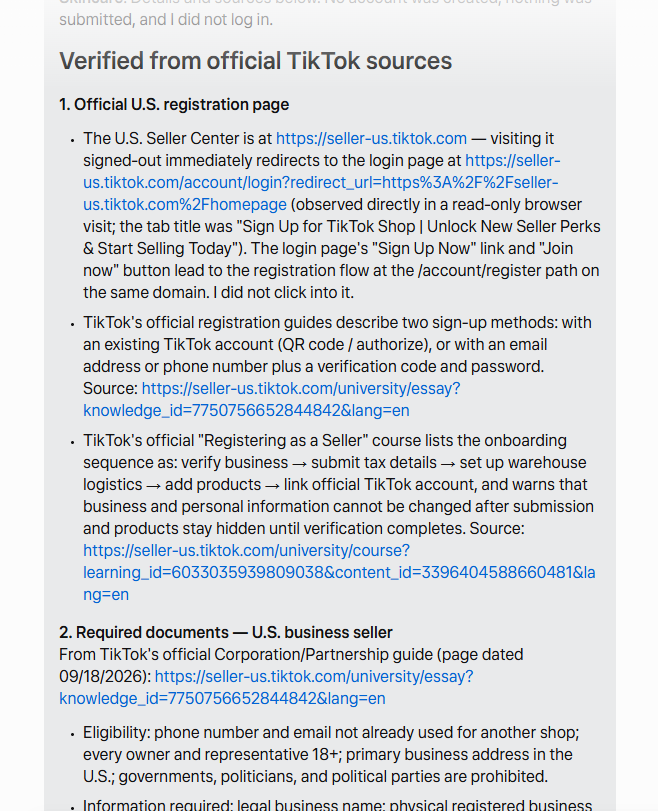
Muse returned a detailed report referencing TikTok Shop Academy resources.
It covered legal business information, EIN documentation, identity verification, beneficial owners, tax forms, bank-account requirements, and seller onboarding.
It also provided a ten-step checklist covering registration, document preparation, compliance, and fee verification.
That was a useful operational deliverable.
The most interesting finding: conflicting fee information
Muse opened its answer by correcting an earlier claim about TikTok Shop fees.
It explained that some third-party sources described higher fees, but the official policy pages it found still listed a 6% referral rate for skincare.
Rather than treating the third-party figures as established facts, Muse acknowledged the conflict and recommended checking the seller’s actual rate inside Seller Center.
This was one of the strongest behaviors observed in our tests.
An AI research assistant becomes more useful when it explains what it cannot establish—not just what it found.
However, the cited public fee material included older policy documentation.
That means the publicly documented 6% rate should not be presented as a guarantee of the applicable rate for every seller in October 2026.
Account-specific terms and more recent notices still need to be checked.
An error in the onboarding advice
Muse described the seller’s initial business-type choice as effectively permanent.
That was too strong.
TikTok published a seller-entity change process in August 2026 for eligible shops, including certain changes involving sole proprietorships, corporations, and partnerships.
The process has conditions and may temporarily affect operations, but the existence of that procedure matters.
A business owner reading Muse’s checklist could otherwise believe a supported change was impossible.
Official reference: TikTok Shop — Changing Your Seller Entity.
Did Muse actually browse the web?
Muse reported visiting multiple TikTok Shop Academy pages and encountering a login barrier at Seller Center.
Its response included detailed source URLs and access limitations.
Those are encouraging signs.
However, our saved test output is a conversation response, not an independent browser activity log.
We can evaluate the information and the sources Muse provided, but we cannot confirm every claimed page visit or click from the answer alone.
We also did not test whether Muse could complete a real seller registration, change account settings, or execute a transaction.
This test demonstrated research and synthesis, not end-to-end autonomous business execution.
BetterBizLab’s assessment
Muse did a good job converting scattered policy material into a usable onboarding document.
Its strongest moment was distinguishing documented fees from unverified reports.
Its weakness was treating at least one operational rule as more absolute than the official guidance supported.
Test 3 verdict: Useful for policy research and checklist creation, provided current rules are verified before implementation.
What Muse Did Well Across All Three Tests
Looking at the results together, three strengths stood out.
1. It produced organized work, not just isolated answers
Each assignment generated a document that could support a real business workflow.
The competitor research produced a comparison and differentiation ideas.
The launch assignment produced a plan and budget.
The seller research produced an onboarding checklist.
This is the kind of output that can reduce administrative preparation time.
2. It often acknowledged missing information
Muse explicitly identified uncertain product sizes, missing business costs, and inaccessible seller-account details.
That is valuable because business decisions frequently fail when estimates are silently treated as facts.
3. It handled multi-part instructions reasonably well
All three prompts contained several requirements and restrictions.
Muse generally maintained the requested structure and reported respecting our prohibitions on purchasing, logging in, or contacting outside parties.
That said, we did not independently audit all background activity. We can only confirm what was visible in the submitted test outputs.
Where Muse Still Needs Human Oversight
The mistakes were not dramatic hallucinations.
They were more ordinary—and potentially more dangerous for business users.
A competitor analysis overlooked another product variant.
A launch plan confused unit sales with customer acquisition.
A marketing budget did not fully reconcile sample product costs.
A seller checklist overstated a restriction that had an official exception.
Each issue could survive a quick review because the surrounding document looked professional.
This suggests a practical risk:
The better an AI-generated business document looks, the easier it can be to overlook a small assumption that changes the decision.
The solution is not to reject AI-generated work.
It is to separate drafting from approval.
For financial work, verify formulas, units, cost definitions, and assumptions.
For market research, check product variants and source dates.
For compliance and platform policies, verify the latest authoritative requirements.
And for any external action, require appropriate human authorization.
For a broader framework on choosing which business processes to automate—and where to retain human approval—see our step-by-step guide to automating a small business with AI.
Privacy and Security: An Important Consideration
Muse is designed to become more useful when connected to personal information and applications.
Meta says the agent operates through a dedicated secure virtual machine and provides user controls over access.
Those architectural claims are important, but they do not eliminate the need to assess operational risks.
On October 20, 2026, The Verge reported that Meta had paused Muse’s conversation-sharing feature after researchers identified thousands of publicly discoverable shared-chat URLs.
That report adds a concrete reason for business users to be cautious about placing sensitive information into an agent.
Source: The Verge — Meta pauses Muse sharing.
Our tests did not involve confidential customer records, private company finances, passwords, or connected business accounts.
We therefore cannot offer a firsthand assessment of Muse’s security under those conditions.
For a small business evaluating any personal AI agent, we recommend starting with public information or synthetic data.
Before connecting email, cloud storage, payment services, or internal systems, establish which permissions are necessary, what actions require approval, how access can be revoked, and how sensitive data is handled.
Is Meta Muse Free?
We were able to access Muse through its web interface and conduct our initial testing without documenting a paid subscription purchase.
That supports a narrow conclusion: a no-payment starting experience was available for our test.
It does not establish the exact free usage allowance, the pricing of every paid tier, or the availability of advanced features for every user.
Those details can change.
For current availability, start with the official Muse website.
Also remember that Muse Wonder’s announced rollout should not be confused with features already available in every free Muse session.
Who Should Try Meta Muse?
Good candidates
Solo business owners: Muse can help turn broad ideas into structured plans, research summaries, and actionable checklists.
Small marketing teams: It can support early competitor research, campaign planning, and content brainstorming.
Operations managers: It can organize public documentation and produce first-draft procedures for human review.
Founders evaluating new markets: It can quickly surface questions, competitors, and assumptions worth investigating.
Use additional caution when…
- Making final pricing or advertising-budget decisions.
- Handling confidential employee or customer information.
- Interpreting regulatory requirements or platform policies.
- Authorizing payments, account changes, or external commitments.
- Relying on current prices, fees, or eligibility rules.
The key distinction is between using an AI agent to prepare a decision and allowing it to make or execute that decision.
Our tests support the first use case much more strongly than the second.
Our Recommended Small Business Workflow
If you want to try Muse, start with a low-risk assignment.
Step 1: Give it a specific business outcome.
Instead of asking, “Research my competitors,” specify the product category, market, price range, comparison fields, and required sources.
Step 2: Require uncertainty labels.
Ask Muse to distinguish verified facts, assumptions, and information it could not access.
Step 3: Request a usable deliverable.
A comparison table, cost scenario, checklist, or draft SOP is easier to review than a long narrative response.
Step 4: Verify the decision-critical details.
Check numbers, dates, current fees, legal requirements, and competitor claims independently.
Step 5: Keep approval authority with a person.
Do not automatically convert a plausible recommendation into a purchase, budget commitment, or operational change.
This workflow preserves the time-saving benefit of an agent while reducing the risk of acting on an incomplete analysis.
Final Verdict: Is Meta Muse Worth Trying for Small Business?
Yes—for research and planning, with clear boundaries.
Our Meta Muse review found that the agent is most useful for preparing business research and structured plans, but its recommendations still require human verification before they become operational decisions.
In our three tests, Muse earned 63/75 points, or 84%, under BetterBizLab’s own scoring framework.
It was capable of creating structured business research, a detailed product-launch plan, and an operational onboarding checklist.
It also showed useful restraint when information was missing or conflicting.
But it made several mistakes that a business owner could easily miss: incomplete competitor context, incorrect assumptions in customer acquisition calculations, undercounted sample economics, and an overly absolute interpretation of seller rules.
Those are not reasons to dismiss Muse.
They are reasons to understand what kind of assistant it is.
Our conclusion: Muse is useful as a research and planning assistant, but these tests do not establish that it can safely operate a business autonomously.
If you are a small business owner, start with one real but low-risk workflow. Measure the quality of the output, check the sources, and record how much human correction it requires.
That is a better way to evaluate an AI agent than judging it by a polished demo or a long list of promised features.
BetterBizLab Testing Disclosure
This review is based on three Muse sessions supplied for BetterBizLab analysis. The business scenarios in the first two tests were synthetic, and the third used public TikTok Shop information. The outputs were evaluated against their stated requirements, with selected facts and calculations independently reviewed.
The 63/75 score is an editorial assessment of these examples, not a statistically representative performance benchmark. We did not test payment execution, connected-account actions, long-running background tasks, or confidential business data handling.
No paid sponsorship or affiliate relationship is asserted in this review.