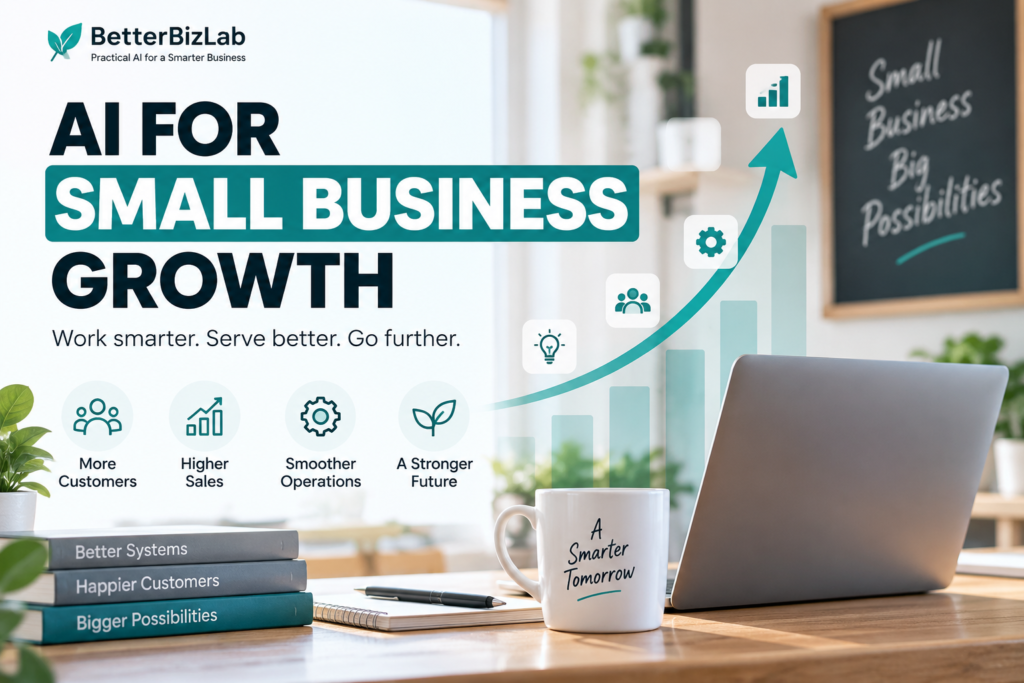
Using AI for small business growth doesn’t mean hiring more people, adding more software, or working longer hours. The real opportunity is using AI to remove the bottlenecks that prevent a small business from growing efficiently.
Sometimes the real constraint is much simpler.
Leads aren’t followed up quickly enough. Customer questions consume too much of the team’s day. Marketing becomes inconsistent when things get busy. Important information is scattered across emails, documents, and spreadsheets. The owner becomes the bottleneck because too many decisions and processes depend on one person.
This is where AI can become useful.
But the goal isn’t to “use more AI.” The goal is to identify what is limiting growth and use AI where it can remove some of that friction.
Quick Answer
AI can support small business growth by helping a company attract potential customers, convert leads, retain existing customers, handle increasing workloads, and learn from business data.
The best place to start is not with an AI tool.
Start with the bottleneck.
If you can identify where customers, time, information, or opportunities are getting stuck, it becomes much easier to decide whether AI can actually help.
That means AI strategy should begin with diagnosis, not software selection. A business struggling to generate demand has a different problem from one generating plenty of leads but failing to follow up consistently.
The framework below is designed to help small businesses identify that difference before adding another AI tool or automation.
How AI for Small Business Growth Works: The Growth Loop
A practical way to think about AI and growth is through five connected stages:
ATTRACT → CONVERT → RETAIN → OPERATE → LEARN
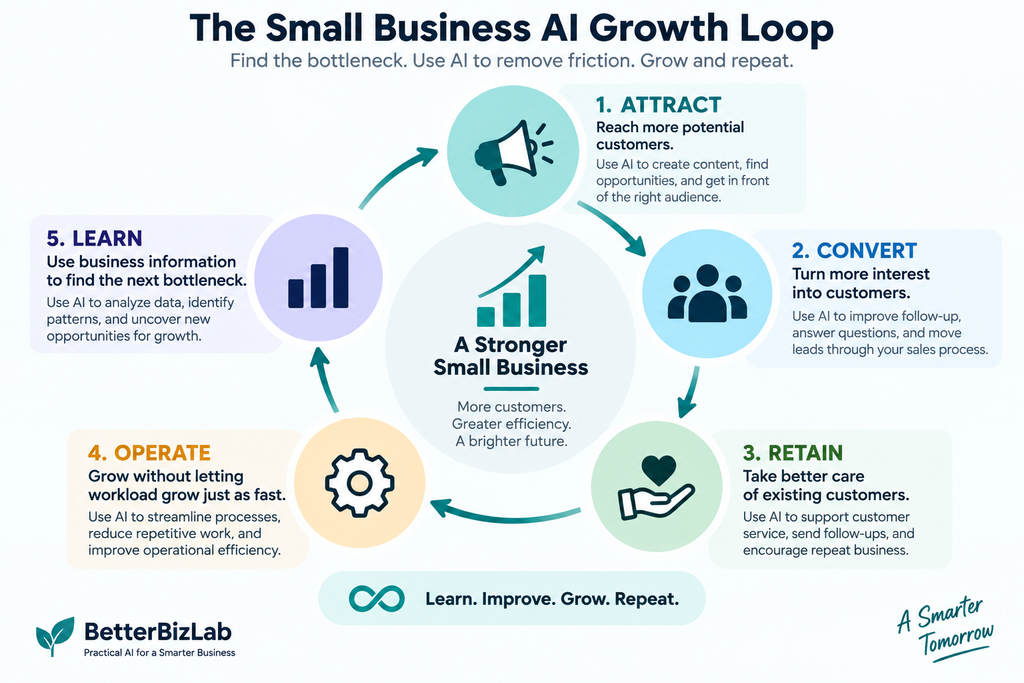
Each stage solves a different growth problem.
AI can support all five, but most small businesses shouldn’t try to automate everything at once.
Find the weakest part of the loop first.
Quick AI Growth Bottleneck Check
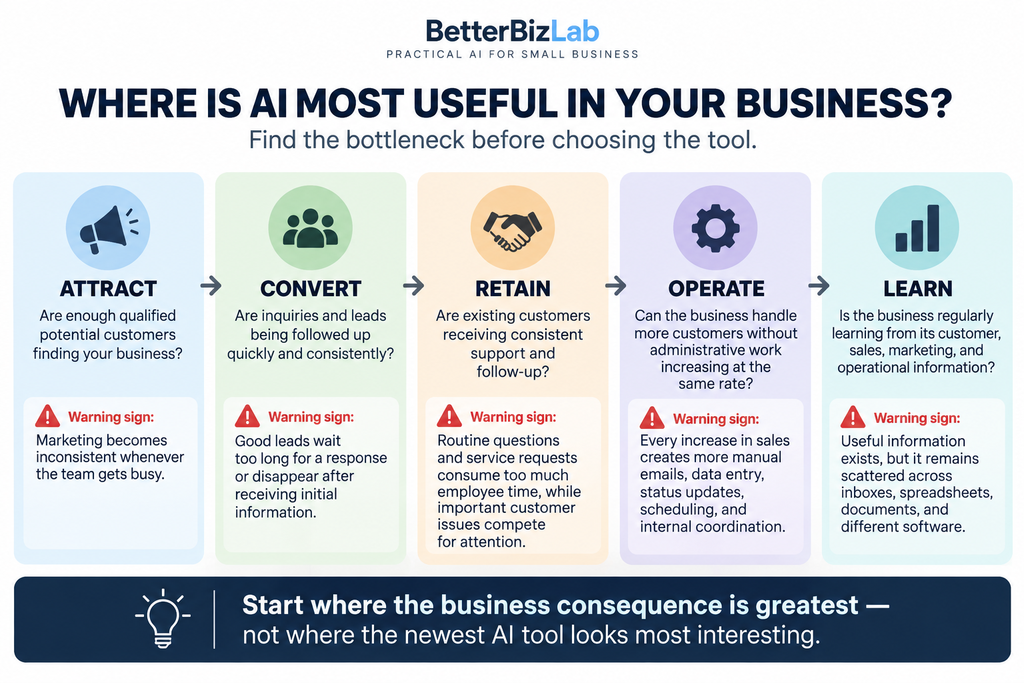
Before choosing a tool, look at each stage of the Growth Loop and ask where your business is consistently losing time, customers, or opportunities.
ATTRACT — Are enough qualified potential customers finding the business?
Warning sign: Marketing becomes inconsistent whenever the team gets busy.
CONVERT — Are inquiries and leads being followed up quickly and consistently?
Warning sign: Good leads wait too long for a response or disappear after receiving initial information.
RETAIN — Are existing customers receiving consistent support and follow-up?
Warning sign: Routine questions and service requests consume too much employee time, while important customer issues compete for attention.
OPERATE — Can the business handle more customers without administrative work increasing at the same rate?
Warning sign: Every increase in sales creates more manual emails, data entry, status updates, scheduling, and internal coordination.
LEARN — Is the business regularly learning from its customer, sales, marketing, and operational information?
Warning sign: Useful information exists, but it remains scattered across inboxes, spreadsheets, documents, and different software.
You don’t need every stage to be perfect. Rate each one as Healthy, Needs attention, or Bottleneck, as in the example below.
Look for the stage where the bottleneck is creating the clearest business consequence. That is usually the first place worth investigating for an AI-assisted workflow.
Example: An 8-Person Service Business
Imagine an eight-person service company that is already generating enough website inquiries.
Its problem isn’t ATTRACT.
The problem is that employees are busy serving existing customers, so new inquiries sometimes wait two or three days for follow-up.
A quick Growth Loop diagnosis might look like this:
ATTRACT — Healthy
CONVERT — Bottleneck
RETAIN — Healthy
OPERATE — Needs attention
LEARN — Needs attention
In this situation, buying an AI content generator would do little to solve the actual growth constraint.
A more useful first workflow could be:
Website inquiry → CRM or spreadsheet → AI prepares a personalized follow-up → human reviews → message is sent → unanswered lead is flagged for the next follow-up.
The AI isn’t replacing the salesperson. It is reducing the repetitive work surrounding the sales conversation so fewer opportunities are lost because the team is busy.
For a detailed implementation example, see our guide on how to automate customer follow-ups with AI for small business.
1. ATTRACT: Reach More Potential Customers
Growth starts with getting in front of the right people.
For many small businesses, the problem isn’t a complete lack of marketing ideas. It’s the time required to consistently research topics, create content, write emails, update website copy, and adapt a message for different channels.
AI can help with the first draft and research-heavy parts of that process.
For example, a small business could use AI to:
Generate initial content ideas based on customer questions.
Turn one useful article into several social-media concepts.
Draft variations of an email campaign.
Organize keyword or competitor research.
Create first drafts of product or service descriptions.
Summarize customer reviews to identify recurring concerns.
If ChatGPT is part of your workflow, see our guide to using ChatGPT for small business for practical ways to apply it beyond basic content generation.
The important distinction is that AI shouldn’t determine your business’s positioning by itself.
Your business provides the customer knowledge, experience, product information, and point of view. AI helps organize and accelerate the work around it.
Example Workflow
Customer questions
→ identify recurring topics
→ AI organizes potential content ideas
→ human selects useful topics
→ AI assists with first drafts
→ human reviews and adds business-specific expertise
→ publish
This is more useful than asking an AI tool to “create 30 social posts” without giving it any real business context.
2. CONVERT: Turn More Interest Into Customers
Getting attention doesn’t automatically create growth.
Potential customers still have to receive the right information and move toward a purchase, appointment, quote, or conversation.
This is where slow or inconsistent follow-up can become a bottleneck.
Imagine a service business receiving inquiries through its website.
A simple AI-assisted workflow might look like this:
New inquiry
→ information captured
→ AI helps categorize the request
→ appropriate initial response is drafted
→ lead enters the company’s follow-up process
→ salesperson reviews and handles the actual sales conversation
AI doesn’t close the important deal by itself; it helps prevent the opportunity from getting lost before a person has a chance to handle it.
This can also apply to quote requests, abandoned inquiries, appointment reminders, FAQs, and other repetitive steps surrounding the sales process.
The key is to automate the predictable parts while keeping people involved where judgment and relationship-building matter.
3. RETAIN: Take Better Care of Existing Customers
Growth isn’t only about finding new customers.
Keeping existing customers, following up after a purchase, resolving problems, and staying connected can be just as important.
AI can help organize some of this work.
For example:
Customer completes a purchase
→ follow-up is scheduled
→ AI helps prepare the appropriate message
→ routine requests follow a defined workflow
→ unusual complaints or exceptions are escalated to a person
A support system can also use an approved knowledge base to help answer repetitive questions faster while routing more complicated issues to an employee.
For repetitive support questions, see our guide on how to automate customer service with AI; for a consistent start with new customers, see how to automate customer onboarding with AI.
The objective is to make sure routine work doesn’t prevent the team from giving attention to customers who actually need it, without making customer relationships feel automated.
4. OPERATE: Grow Without Letting Administrative Work Grow Just as Fast
A business can increase sales and still become less efficient.
More customers often create more emails, orders, documents, status updates, internal questions, scheduling, reporting, and repetitive administrative work.
If every increase in revenue requires the same increase in manual work, growth becomes harder to manage.
This is where AI-assisted workflows can create operational leverage.
Consider a simple process:
Order or request received
→ information captured
→ data organized
→ appropriate team member notified
→ routine next step triggered
→ exception sent to a person
AI can also help small businesses document processes that previously existed only in someone’s head.
For example, a manager can provide the real steps of a recurring process and use AI to organize those steps into a clearer Standard Operating Procedure (SOP).
If process documentation is your bottleneck, our guide to creating SOPs with ChatGPT walks through a practical way to structure the process.
The business remains the source of truth.
AI provides structure.
That makes it easier to train employees, maintain consistency, and eventually identify which parts of the process might be appropriate for automation.
5. LEARN: Use Business Information to Find the Next Bottleneck
The final part of the growth loop is learning.
Small businesses generate useful information constantly:
Sales data.
Customer questions.
Support requests.
Reviews.
Marketing results.
Website inquiries.
Operational problems.
Employee feedback.
The problem is that the information often lives in different systems and rarely gets reviewed together.
AI can help summarize and organize this information so a business owner can identify patterns worth investigating.
For example, AI might help organize hundreds of customer comments into recurring themes.
But there is an important distinction:
AI can identify a pattern. Management still has to decide what the pattern means and what to do about it.
That human judgment becomes especially important when the data is incomplete, sensitive, or connected to an important business decision.
Once the business identifies its next constraint, the loop begins again:
LEARN → ATTRACT → CONVERT → RETAIN → OPERATE → LEARN
How to Pick Your First AI Growth Bottleneck
Don’t begin by asking:
“What AI tool should we buy?”
Start with:
“Where are we repeatedly losing time, customers, or opportunities?”
A good first AI workflow usually has four characteristics.
High Repetition
The task happens frequently enough that improving it matters.
High Time Cost
Employees or owners repeatedly spend meaningful time doing essentially the same work.
Clear Desired Outcome
You know what successful completion looks like.
Easy Human Review
Someone can quickly check the AI-assisted output before it creates a meaningful business consequence.
For example, drafting routine follow-up emails may fit these criteria well.
Making a final decision about a contract probably doesn’t.
Where AI Should Not Make the Final Decision
AI can assist with important work without being given final authority over it.
Small businesses should be particularly careful with areas such as:
Pricing exceptions.
Contracts and legal commitments.
Sensitive customer complaints.
Financial decisions.
Hiring and HR decisions.
Confidential business or customer information.
High-impact communications.
In these situations, AI may help summarize information, organize documents, identify questions, or prepare a draft.
The consequential decision should remain with the appropriate person.
This isn’t an argument against automation.
It’s a way to automate more responsibly.
Avoid the “More Tools = More AI” Trap
Another common mistake is building an unnecessarily complicated AI stack.
One tool generates content.
Another summarizes it.
A third moves the information.
A fourth monitors the automation.
A fifth manages the other tools.
Eventually, the business has created another system someone has to maintain.
For a small team, simpler is often better.
Start with one bottleneck.
Choose one workflow.
Use the minimum number of tools required.
Measure whether it actually improves the process.
Then decide whether the next automation is worth adding.
When you’re ready to compare platforms, our guide to the best AI automation tools for small business can help you match tools to the workflow you actually need.
How to Measure Whether AI Is Actually Helping Growth
Small-business AI adoption is already expanding across areas such as marketing, sales, data analysis, content creation, and automation, according to recent research from U.S. Bank.
AI adoption isn’t the objective.
Business improvement is.
Before implementing a workflow, establish a simple baseline.
Depending on the process, you might measure:
Time required to complete the task.
Response time.
Number of leads followed up.
Customer-support resolution time.
Quotes or proposals completed.
Errors or rework.
Number of tasks completed per week.
Conversion or retention metrics where appropriate.
Then compare the process after the AI-assisted workflow has been used consistently.
If the tool saves time but creates additional corrections, software costs, or management work, include those costs in the evaluation too.
The goal is not to prove that AI works.
The goal is to determine whether this particular workflow works for your business.
A Simple Way to Start
You don’t need an AI transformation plan to begin.
Pick one recurring problem.
Document how the process works today.
Identify the repetitive step.
Choose where AI could assist.
Define where human review occurs.
Test the workflow.
Measure the result.
Then decide whether to keep it, improve it, or stop using it.
Once that workflow works reliably, move to the next bottleneck.
For a broader implementation framework, see how to automate a small business with AI.
That’s how AI becomes part of a business system rather than another tool employees experimented with for a week and forgot.
Final Thoughts
AI for small business growth works best when it gives a small team more leverage without adding unnecessary complexity.
Used carefully, AI can help a business respond faster, follow up more consistently, organize information, reduce repetitive work, and handle more activity without allowing administrative complexity to grow at the same rate.
The businesses that benefit most won’t necessarily be the ones using the most AI.
They’ll be the ones that know where AI belongs in the business — and where it doesn’t.
Start with the bottleneck.
Build one useful workflow.
Keep human judgment where it matters.
Then use what you learn to improve the next part of the growth loop.